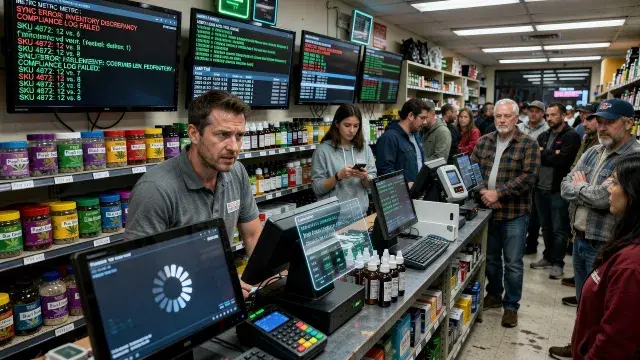
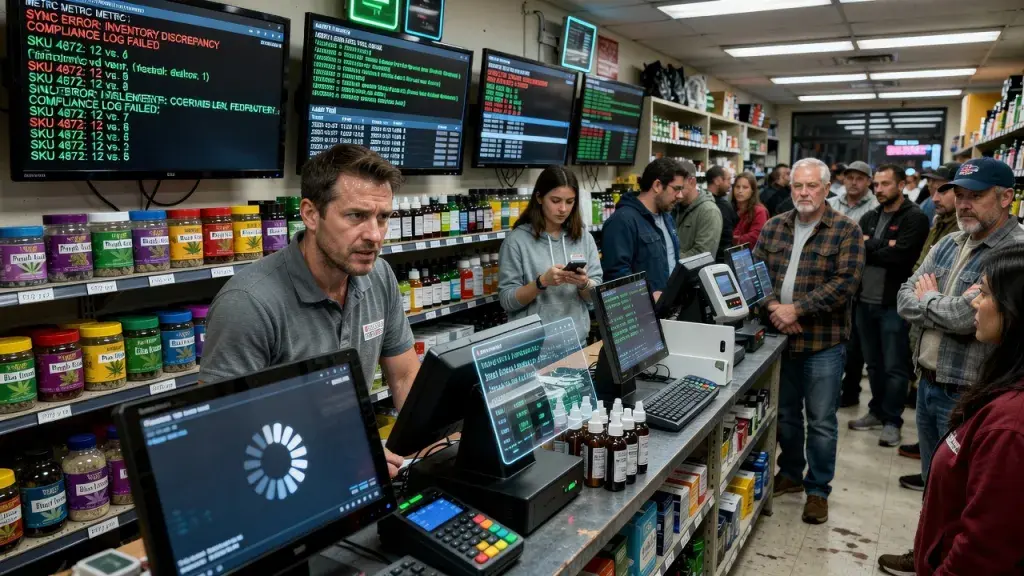
A dispensary's point-of-sale terminal freezes during a Friday rush. The budtender waits. The line backs up. Somewhere behind that spinning wheel sits a stack of code nobody on staff will ever see, built by a vendor who was probably more focused on shipping a feature than making sure the checkout process actually holds up under load. That gap between "it works in the demo" and "it works at 6pm on a payday" is not a small thing in cannabis retail. It's the whole ballgame - sorry, the whole business.
Why software quality is a retail operations problem, not just an IT one
Cannabis retail runs on more software than most people realize: seed-to-sale tracking through state systems like METRC, point-of-sale platforms tied to inventory and tax calculation, age-verification tools at the door, compliant labeling software, and increasingly, cashless payment workarounds given how limited traditional banking still is for plant-touching businesses. Every one of those systems has to talk to the others without dropping a transaction, miscounting a SKU, or losing a compliance log. When software is built cheaply and fast - the industry-wide pattern of prioritizing time-to-market over reliability - dispensaries inherit the consequences directly. A dropped sync between POS and state tracking isn't an inconvenience. It's a discrepancy that shows up in an audit.
The hidden cost of "good enough" systems
Operators tend to judge software vendors on price and feature lists, not on how the system behaves when something goes wrong. That's understandable - margins are tight under 280E, and nobody wants to pay a premium for something invisible like reliability. But the thing is, unreliable inventory software creates real financial exposure. Inventory shrinkage that can't be explained by theft or waste often traces back to reconciliation errors between systems that were never built to stay in sync. A compliance log that silently fails to record a manifest update can turn into a regulatory finding months later, long after anyone remembers what happened. Multi-state operators feel this most acutely, since they're often running five or six state-specific configurations of the same underlying software, each with its own quirks and failure modes.
What operators should actually ask vendors
Fair enough, most dispensary owners aren't engineers and shouldn't have to evaluate code quality directly. But there are practical questions that reveal a lot:
- How does the system behave during a state tracking outage - does it queue transactions or does it just stop?
- What's the audit trail if a batch record gets edited after the fact?
- How often does the vendor push updates, and do those updates require downtime during business hours?
- Is there a documented process for reconciling POS data against METRC or the equivalent state system?
Vendors who can answer these cleanly, without hand-waving, are usually the ones who built the system with compliance and reliability in mind from the start rather than bolting it on after a state regulator asked for it.
A slower, sturdier approach pays off in the long run
In practice, the operators who avoid painful audits and compliance headaches aren't the ones with the flashiest dashboards. They're the ones whose systems quietly do the boring work correctly, every single time. That's not exciting to sell. It doesn't make for a good demo. But in a retail environment where a single reporting error can mean a fine, a suspended license, or a failed inspection, boring and correct beats fast and fragile every time. Cannabis retail is still a young regulated industry, closer in spirit to how alcohol retail matured decades ago than to a typical tech startup. Software built for it should be held to that standard - not the standard of an app that just needs to look good long enough to get funded.