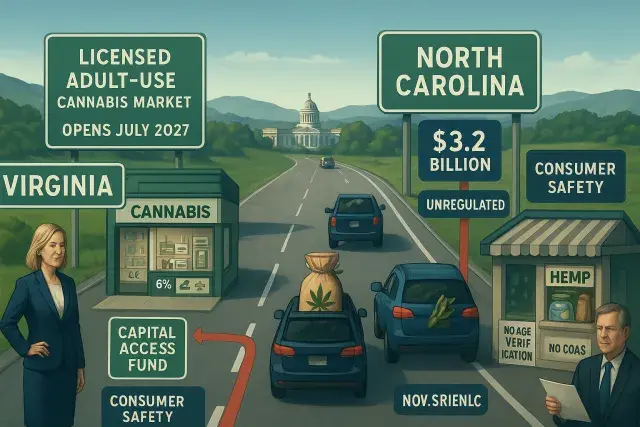
Virginia is set to open a licensed, adult-use cannabis retail market in July 2027, and North Carolina lawmakers are already doing the math on what that means for their state's tax base. Governor Abigail Spanberger announced a framework deal this week that would authorize up to 350 licensed cannabis retailers across the Commonwealth - creating a functioning, compliant market less than an hour's drive from many North Carolina residents. For a state sitting on what its own advisory council estimates as a $3.2 billion unregulated cannabis market annually, the timing could not be more uncomfortable.
The border-bleed dynamic is not new to regulated retail. States that legalized alcohol sales, launched lotteries, or approved casino gaming have watched neighboring residents cross state lines for access to legal products - and the tax revenue that follows them. The pattern is predictable enough that Representative Zack Hawkins (D-Durham), who serves on Governor Josh Stein's cannabis advisory council, put a rough number on it: around 10 percent of potential buyers could reasonably divert their spending across the Virginia line once retail opens. That may sound modest, but applied against a multi-billion-dollar baseline, even a fraction of redirected consumer spending represents meaningful lost excise revenue for North Carolina. Operators in other early-adopting states have tracked this exact dynamic - resources like cannabis dispensary software nevada reflect how mature markets have built infrastructure to capture and retain in-state consumer demand - and the lesson is consistent: proximity to a legal market accelerates the pressure on holdout states to act.
Virginia's proposed structure is straightforward as licensed cannabis frameworks go. A six percent excise tax layered on top of standard sales tax will apply to all cannabis purchases. Seventy-five percent of that excise revenue is earmarked for a capital access fund - a direct acknowledgment that new licensees operating in a tightly regulated environment need financial support to survive early operating years. That's a real tension in every new adult-use market: compliance costs, seed-to-sale tracking requirements, compliant packaging mandates, and lab testing fees hit small and independent operators hardest in year one. Directing tax revenue back into operator capitalization is one way regulators have tried to keep license holders solvent long enough to build sustainable businesses.
North Carolina Is Still Working Through Hemp and Kratom
While Virginia moves toward retail licensing, North Carolina's legislative focus remains on hemp-derived products and kratom. A Senate bill currently in committee would impose fines on businesses that sell those products to minors - a baseline consumer protection measure that most regulated states treat as table stakes. Senate leader Phil Berger has indicated publicly that the bill doesn't go far enough, though no specific course of action has been settled on. That's where the state's regulatory conversation actually sits right now: not on adult-use cannabis licensing or excise tax structures, but on whether to impose age-verification requirements for hemp gummies and functional beverages already on retail shelves statewide.
The gap between where North Carolina's legislature is and where a functional licensed cannabis market would require it to be is substantial. A regulated adult-use framework demands licensing infrastructure, a regulatory body with enforcement authority, seed-to-sale tracking protocols, product testing and COA requirements, compliant packaging and labeling rules, and a payment compliance framework - all of which take years to build and operationalize. Virginia's deal, if it clears its own legislature, gives North Carolina a working regional model to study. Hawkins expects that's exactly what will happen: lawmakers in Raleigh will look at how the Commonwealth structured its market and use it as a reference point.
What Virginia's Framework Signals for Regional Operators and Future Licensees
For any multi-state operator, wholesaler, or cannabis brand watching this region, the picture is coming into focus. Virginia opens in mid-2027 with a capped license count - 350 retailers - which suggests regulators are trying to control market entry pace and avoid the supply glut that has compressed wholesale pricing in states like Oregon and Michigan. A capital access fund backed by excise tax revenue is a more deliberate operator-support mechanism than most states have built at launch. That could matter for brand and supply chain partners trying to assess which new markets will produce viable wholesale customers rather than undercapitalized licensees burning through inventory at unsustainable margins.
North Carolina, for its part, remains a significant unregulated market with no near-term licensing timeline in place. The advisory council's April recommendation - a tightly regulated system focused on consumer safety and revenue generation - has not translated into a legislative vehicle. Until it does, the state will continue watching tax dollars leave with consumers who cross into Virginia, buy legally at a licensed dispensary with tested, labeled product, and drive home. That's a consumer safety argument as much as a fiscal one. Unregulated market products carry no mandatory lab testing, no COA, no compliant dosage labeling, and no age verification at point of sale. A licensed framework doesn't solve all of that overnight. But it changes the baseline.