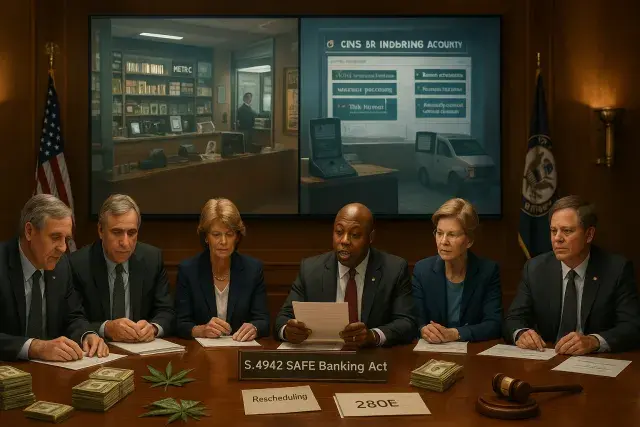
A bipartisan group of U.S. senators has refiled the Secure and Fair Enforcement Banking Act - better known as the SAFE Banking Act - in a direct bid to end the financial isolation that has defined cannabis business operations since the first state-licensed dispensaries opened their doors. Led by Sen. Jeff Merkley (D-OR) and cosponsored by Sens. Lisa Murkowski (R-AK), Elizabeth Warren (D-MA), and Steve Daines (R-MT), the newly filed S.4942 arrives days before a Senate hearing on the Trump administration's move to reschedule marijuana under federal law. The timing is not accidental.
For dispensary operators, the bill's reintroduction lands at a moment when the operational costs of cash dependency are well understood - and deeply felt. Armored car services, on-site vaults, cash counting infrastructure, and the insurance premiums that come with holding large physical currency reserves are line items that licensed retailers in every adult-use and medical cannabis state absorb as a cost of doing business under federal prohibition. Operators using systems like Colorado cannabis POS platforms have built workaround workflows around cashless ATMs and PIN debit to reduce register risk, but those solutions carry their own fees and compliance friction. Full, standard banking access would change the underlying economics of retail operations meaningfully.
The SAFE Banking Act is not a new idea. Earlier versions passed the House of Representatives multiple times over several congressional sessions - a fact that makes its continued failure in the Senate one of the more frustrating policy loops in regulated cannabis. The Senate Banking Committee approved a version of the measure in 2023, but it never reached a floor vote and expired at the end of the 118th Congress. What's striking this time is the position of Sen. Tim Scott (R-SC), who now chairs the Senate Banking Committee. Scott has opposed cannabis banking reform in the past. Recently, though, he acknowledged the bind openly - calling the situation a "quandary" for cannabis businesses and banks, and pointing to the public safety risk of cash-heavy dispensary operations as a reason the banking question needs resolution. That's not an endorsement of cannabis, but it is a significant shift in tone from the committee chair who controls whether the bill gets a hearing.
What the Bill Actually Does - and What It Doesn't
S.4942 is structured around a straightforward protection: banks and other federally regulated financial institutions would be shielded from federal punishment - asset seizure, regulatory sanctions, loss of federal deposit insurance - for providing standard financial services to cannabis businesses operating legally under state law. That means business checking accounts, merchant processing, lines of credit, and payroll services that most licensed retailers in any other industry take for granted. The bill also contains provisions extending access to federally backed mortgage loans for cannabis industry workers, a provision that addresses a quieter but real financial exclusion affecting employees at every level of the supply chain.
Here's the catch, though. SAFE Banking does not legalize cannabis at the federal level. It does not resolve 280E - the Internal Revenue Code provision that bars cannabis businesses from deducting ordinary business expenses, creating effective tax rates that can significantly exceed those of comparable non-cannabis retail businesses. It does not touch licensing, scheduling, or interstate commerce. What it does is remove the federal threat that has kept most mainstream banks on the sidelines, leaving dispensaries to piece together financial services through smaller credit unions, cannabis-specific fintech providers, and workarounds that add cost at every transaction point.
The Cash Problem Is a Safety and Compliance Problem
Sen. Scott's public safety framing is worth taking seriously, because operators have been making the same argument for years. A dispensary holding large cash reserves is a target. That reality shapes everything from store layout and staffing decisions to the location choices multi-state operators weigh when opening new retail footprints. Cash-intensive operations also create compliance complexity - reconciling physical cash against seed-to-sale tracking records, point-of-sale logs, and state inventory systems like METRC is a manual, error-prone process. Discrepancies between cash counts and electronic records can trigger regulatory scrutiny, even when the underlying cause is operational rather than fraudulent.
Banking access would not eliminate compliance obligations - state regulators would still require transaction-level reporting, age verification, and inventory accountability - but it would make the financial paper trail cleaner and more auditable. Standard bank statements are a more defensible compliance record than hand-counted cash logs.
What Operators Should Watch
The bill's reintroduction does not guarantee passage. Previous versions cleared the House and stalled in the Senate, and the same structural dynamic that killed earlier iterations - cannabis remains a Schedule I controlled substance - still applies unless rescheduling moves forward in parallel. Operators should not restructure their financial operations in anticipation of SAFE Banking becoming law. What the renewed bipartisan support does signal is that the political calculus is shifting, and that a Senate Banking Committee chair willing to frame the bill in public safety terms gives the measure better positioning than it has had in recent sessions.
For multi-state operators, cannabis-focused lenders, payment processors, and the fintech vendors who have built businesses around the industry's banking gap, the bill's progress will be worth monitoring closely. If SAFE Banking does eventually pass, the competitive dynamics of cannabis financial services will change - and the companies that have built infrastructure for a cash-dependent industry will need to adapt their value propositions accordingly. That's a business planning question, not just a legislative one.