Running a cannabis dispensary means operating inside one of the most regulated retail environments in existence - where a single inventory discrepancy can trigger a compliance audit, and a slow checkout line can cost you repeat customers. The businesses that thrive aren't necessarily the ones with the best product selection; they're the ones that have built efficient, accurate, and legally airtight back-end operations. That's where cannabis retail software becomes less of a convenience and more of a competitive necessity.
Most dispensary owners encounter the same pain points: manual inventory counts that don't match state reporting systems, budtenders spending too much time on administrative tasks, and compliance paperwork that pulls management away from growing the business. The right marijuana dispensary POS system addresses all of these problems simultaneously - not by adding complexity, but by automating the workflows that create the most friction. When your point-of-sale system, inventory tracking, and compliance reporting all communicate through a single platform, errors compound far less and correcting them takes far less time.
This article breaks down exactly how modern cannabis retail software improves each major operational layer of a dispensary - from the moment a customer walks in to the moment a compliance report gets submitted. Whether you're evaluating your first weed store POS system or reconsidering a platform that's no longer scaling with your business, the following sections give you a clear-eyed framework for what good software actually does and why it matters.
Understanding Cannabis Retail Software and Why It's Different From General Retail Technology
General retail software is built around universal commerce principles: track stock, process payments, generate receipts. Cannabis retail is built around all of that - plus a regulatory layer that changes by state, sometimes by county, and occasionally mid-license-cycle. The software category that serves dispensaries isn't just retail management with a cannabis skin on it; it's purpose-built to handle the specific compliance, product categorization, and reporting requirements that no off-the-shelf grocery or apparel POS would accommodate.
What Makes Cannabis Retail Operations Uniquely Complex
Every legal cannabis market imposes purchase limits - typically defined by product type and THC content - and dispensaries are legally responsible for enforcing them at the point of sale. That means your checkout process must be capable of calculating cumulative daily purchase totals per customer in real time. A standard retail system has no framework for that kind of transaction rule. Beyond limits, cannabis products require specific labeling, batch tracking, and chain-of-custody documentation that traces each item from cultivator to consumer.
Add to this the variance between medical and adult-use customer categories, age verification requirements, and the need to maintain records that state regulators can audit on short notice, and it becomes clear why generic retail technology fails dispensaries almost immediately. Cannabis retail software is designed from the ground up to treat compliance as a core function, not an afterthought.
How Integrated Platforms Differ From Standalone Tools
Some early dispensaries attempted to patch together separate systems - a basic POS, a spreadsheet for inventory, a third-party compliance tool - and found that data syncing between them was unreliable and time-consuming. An integrated cannabis retail platform connects these functions in a single environment, which means that when a sale is completed at the dispensary point of sale terminal, inventory automatically adjusts, customer purchase history updates, and the transaction is flagged for regulatory reporting - all without manual data entry.
The operational difference is significant. Staff errors drop because there are fewer touchpoints where human input can go wrong. Reporting becomes faster because the data is already organized in the format regulators require. And management gains a real-time view of what's happening across every operational dimension simultaneously.
Who Uses Cannabis Retail Software and How Their Needs Differ
A single-location boutique dispensary has different software requirements than a multi-state operator running a dozen stores. Small operators need simplicity, affordability, and reliable compliance support. Larger organizations need centralized reporting, role-based access controls, and the ability to push product menus or pricing updates across locations simultaneously. Most leading cannabis retail software platforms offer tiered configurations that serve both, though the evaluation criteria for each will differ substantially.
Dispensary Point of Sale: Speed, Accuracy, and the Customer Experience
The dispensary point of sale is the most visible operational component in any cannabis store. It's where budtenders spend a large portion of their shift, where customers form their strongest impressions of the business, and where compliance enforcement happens in real time. A weak POS slows everything down; a strong one creates a checkout experience that feels effortless to the customer while doing significant regulatory work in the background.
Core Features That Define a High-Performance Dispensary POS
At minimum, a functional dispensary point of sale must handle product lookup by name, SKU, or category; apply customer-specific pricing tiers or loyalty discounts; enforce purchase limits by product type; and process multiple payment methods, including cash management workflows. Beyond that baseline, the best systems offer ID verification scanning, customer check-in integration, and the ability to pull up a patient's purchase history before the transaction begins.
Speed matters more than most operators initially expect. A checkout that takes four minutes per customer in a busy dispensary creates a backlog that frustrates both customers and staff. Optimizing the POS workflow - through features like quick-add buttons, suggested product pairings, and pre-saved shopping carts - can meaningfully reduce transaction time without cutting corners on compliance steps.
Customer Management and Loyalty Programs Built Into the POS
Modern cannabis retail software treats the POS as the primary data collection point for customer relationship management. Each transaction builds a profile: purchase frequency, preferred product categories, average order value, medical versus recreational status. This data powers loyalty programs that automatically apply rewards at checkout, send reorder reminders, or trigger promotional messaging - all within whatever marketing communications regulations apply in the operator's state.
Dispensaries that use loyalty programs tied directly to their weed store POS system consistently report higher customer retention rates than those offering no program or running a disconnected paper-based one. The integration matters: a loyalty system that requires staff to manually log points is one that staff will eventually stop using consistently.
Hardware Compatibility and Checkout Environment Design
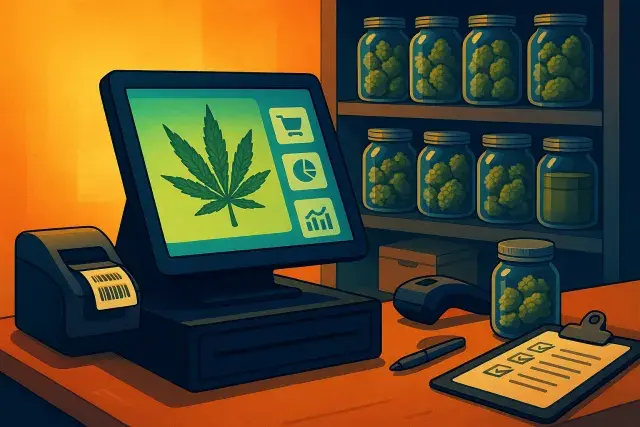
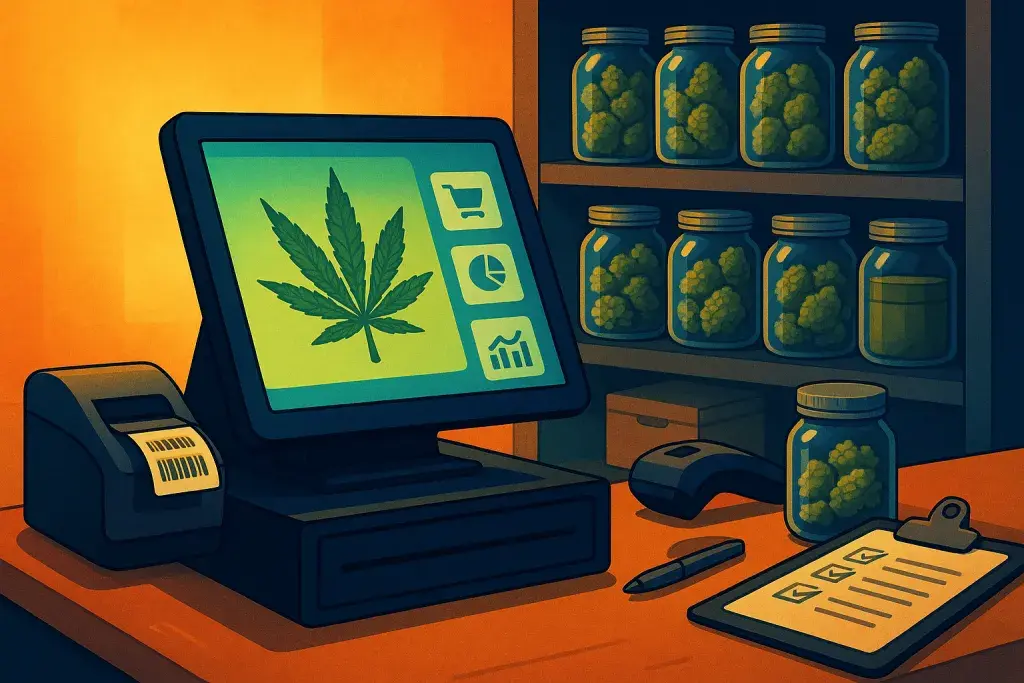
The physical checkout setup affects workflow as much as the software does. Dispensary POS platforms are typically designed to work with specific hardware configurations - touchscreen terminals, receipt printers, barcode scanners, and cash drawers. Some also support tablet-based mobile checkout for express lanes or outdoor events. Choosing software that's compatible with durable, purpose-built hardware prevents the kind of technical failures that create delays during peak hours.
Marijuana Inventory Management: Precision From Seed to Sale
Inventory is where cannabis compliance and business operations intersect most directly. Every unit in a dispensary was cultivated, processed, tested, and transferred along a documented chain. At the retail end of that chain, the dispensary must account for every gram - not just for business profitability, but because state regulators track this data and discrepancies raise immediate flags.
How Real-Time Inventory Tracking Reduces Shrinkage and Errors
Effective marijuana inventory management means knowing your stock levels accurately at any given moment - not at the end of the day when someone runs a manual count. Real-time tracking, tied to the point of sale, deducts inventory automatically when a product is sold. This prevents the common problem of selling items that are no longer in stock, which generates customer complaints and ruins operational flow.
Shrinkage - the difference between recorded inventory and actual physical stock - is a persistent challenge in cannabis retail. It can result from theft, mislabeling, improper receiving, or simple human error during manual counts. Software that tracks inventory at the batch and unit level, and flags discrepancies between system records and physical counts, gives management an auditable trail and a tool for identifying where losses originate.
Purchase Orders, Receiving, and Supplier Management
Inventory management doesn't start when a product hits the shelf; it starts when a purchase order is created. Cannabis retail software that includes a receiving workflow allows staff to scan incoming products, match them against the transfer manifest from the supplier, and flag any discrepancies before products are put into sellable inventory. This step is critical for compliance because state systems like METRC track transfers, and what a dispensary receives must match what its records show.
Supplier management features let operators track vendor performance over time - fill rates, delivery accuracy, product quality - and make more informed purchasing decisions. In a market where product availability fluctuates significantly with harvest cycles and regulatory approvals, that data is operationally valuable.
Low-Stock Alerts, Reorder Points, and Inventory Forecasting
A well-configured marijuana inventory management system doesn't just tell you what you have - it tells you what you're about to run out of and prompts action before a stockout occurs. Low-stock alerts, set by product category or individual SKU, notify buyers when inventory falls below a defined threshold. Reorder points can be tied to historical sales velocity, so a product that sells faster during certain periods triggers earlier restocking than a slow mover.
Some advanced platforms offer forecasting tools that analyze sales trends and help operators project future inventory needs. This reduces the over-ordering that ties up cash in slow-moving stock and the under-ordering that leaves shelves empty during demand peaks.
Cannabis Compliance Software: Staying Audit-Ready Without Constant Manual Effort
Compliance is the operational dimension that separates cannabis retail from virtually every other consumer goods category. Regulators don't just expect dispensaries to follow the rules; they expect documented proof that the rules were followed, transaction by transaction. Cannabis compliance software automates this documentation layer, making audit readiness a byproduct of normal operations rather than a separate project that requires additional labor.
State Traceability System Integration: METRC and Beyond
Most US cannabis markets require dispensaries to report sales and inventory data to a state-mandated traceability system, with METRC being the most widely adopted. Every product sold at the dispensary point of sale must be reported to METRC with accurate batch numbers, quantities, and customer information. Doing this manually is both time-consuming and error-prone.
Cannabis compliance software that integrates directly with METRC automatically pushes required data to the state system after each transaction. This eliminates the dual data-entry process and reduces the risk of mismatched records between the dispensary's internal system and the state's official logs. When an audit occurs - and in mature cannabis markets, audits are routine - the documentation is already organized and accurate.
Purchase Limit Enforcement and Age Verification
Two of the most fundamental compliance requirements at the point of sale are age verification and purchase limit enforcement. Cannabis compliance software handles both automatically. Customer ID is scanned at check-in, age is verified against the transaction date, and the system either proceeds or flags the customer for a staff review. Purchase limit calculations run in the background, tracking how much a customer has already bought that day across product types and stopping the transaction if a limit would be exceeded.
These aren't features a dispensary should rely on staff memory or manual calculation to enforce. One violation - whether it's an accidental sale to a minor or an over-limit transaction - can result in significant fines or license consequences. Automation removes human error from the equation at the highest-risk compliance points.
Reporting Tools That Simplify Regulatory Submissions
Beyond transaction-level compliance, dispensaries face periodic reporting requirements: daily sales summaries, inventory reconciliation reports, and in some cases, patient counts for medical programs. Cannabis retail software that generates these reports in the required state-specific formats saves management hours each reporting cycle. Some platforms also maintain historical report archives, so retrieving records for a regulatory inquiry doesn't require digging through filing cabinets or reconstructing data from disconnected sources.
Weed Store POS System Efficiency: Streamlining Daily Operations
Beyond compliance and inventory, a weed store POS system influences dozens of smaller operational decisions every day. Shift management, cash handling, employee permissions, menu updates - each of these functions is either made easier or harder by the software managing them. Dispensaries that have optimized their POS operations report measurable improvements in staff efficiency and a reduction in the administrative overhead that pulls management away from customer-facing work.
Employee Management, Role Permissions, and Shift Accountability
A dispensary POS that includes employee management tools allows operators to define exactly what each staff role can access. Budtenders may process sales and view product information but not adjust inventory quantities or access financial summaries. Managers can run reports, approve voids, and modify pricing. Owners have full system access. This role-based architecture protects against both accidental errors and intentional misconduct by limiting what each user can touch.
Shift accountability features - like session-level cash drawer tracking - give managers a clear record of who handled which transactions and when. When cash discrepancies occur, the data trail narrows the investigation to a specific shift and terminal, rather than leaving management guessing across an entire day's operations.
Menu Management and Digital Display Integration
Product menus in cannabis retail change frequently - new arrivals, price adjustments, sold-out items. A weed store POS system that connects directly to digital menu displays and online menus means a single update in the back-end system propagates everywhere simultaneously. Staff don't have to manually update whiteboard menus or website listings separately from the POS inventory, and customers see accurate availability whether they're in store or browsing online.
This connection also supports promotional pricing - automatically applying a discount to a specific product category during happy hour windows, for instance - without requiring staff to manually remember and apply it at checkout.
End-of-Day Reconciliation and Financial Reporting
Because most cannabis dispensaries still operate in heavily cash-based environments - a consequence of banking access limitations in many markets - cash management is a significant operational concern. A cannabis retail software platform with strong cash management tools guides staff through end-of-day drawer counts, flags discrepancies against expected totals, and maintains a running log of cash in and out throughout the shift. This creates the financial accuracy that accountants and auditors require without relying on staff to perform manual calculations correctly every single day.
Choosing the Right Cannabis Retail Software: What to Evaluate Before Committing
The cannabis software market includes a range of platforms that vary considerably in depth, reliability, and specialization. Choosing incorrectly and then switching platforms midstream is expensive - both in direct costs and in the operational disruption of migrating data and retraining staff. A careful evaluation process, focused on the factors that matter most for your specific operation, protects against that outcome.
Compliance Coverage for Your Specific State Market
Not every cannabis retail software platform supports compliance reporting in every US state. Before evaluating any other features, verify that the platform has active, maintained integrations with the traceability system your state uses. A platform with excellent general features but no METRC integration is unusable in a METRC-required market. Ask vendors directly about their integration maintenance practices - regulatory requirements change, and integrations that aren't kept current become liability rather than asset.
Scalability, Support, and System Reliability
A single-location operator evaluating software should still consider what happens if the business grows. Does the platform support multi-location management? Can it handle higher transaction volumes without performance degradation? What does the vendor's uptime history look like, and what's their process when the system goes down during peak hours?
Support quality deserves serious scrutiny. Cannabis retail doesn't operate nine-to-five, and a POS outage at 7 PM on a Friday is a real operational crisis. Platforms that offer 24/7 phone or live chat support are meaningfully different from those that respond to tickets within 48 hours. Talk to current users of any platform you're evaluating - their experience with support responsiveness is more reliable than any sales pitch.
Training Requirements and Staff Adoption
Even the best-designed system underperforms if staff don't use it correctly. Evaluate the learning curve for budtenders specifically, since they interact with the POS more than any other employee group. A platform with an intuitive checkout interface and minimal required steps per transaction will see faster adoption and fewer errors than one that buries key functions behind multiple menu layers.
- Ask vendors for a live demo with a realistic transaction scenario, not just a slideshow
- Request access to training materials and assess how clear and comprehensive they are
- Find out whether onboarding includes hands-on setup support or just documentation
- Confirm how software updates are communicated and whether training is provided when major features change
The Operational ROI of Investing in Purpose-Built Cannabis Software
The business case for purpose-built cannabis retail software isn't difficult to construct - but it's worth being specific about where the return actually comes from, rather than accepting vague promises about efficiency gains.
Time Savings Across Compliance and Reporting Tasks
In dispensaries that manage compliance reporting manually, staff and management routinely spend hours each week preparing submissions, reconciling inventory records, and correcting errors caught during the reconciliation process. Automating these workflows - through integrated cannabis compliance software - converts those hours into time that can be directed toward customer service, staff development, or business growth activities. The reduction in compliance labor costs alone often justifies software investment within a relatively short period of operation.
Reducing Costly Errors Before They Become Regulatory Problems
A compliance violation that results in a fine or license restriction is far more expensive than any software subscription. Cannabis retail software reduces the frequency of the specific error types that regulators typically flag: purchase limit violations, inventory discrepancies between internal records and state systems, and incomplete transaction documentation. The cost avoidance generated by preventing even one significant compliance incident can dwarf the annual cost of the software itself.
Inventory Accuracy and Its Impact on Profitability
Accurate marijuana inventory management directly affects gross margin. When inventory records are imprecise, dispensaries make suboptimal purchasing decisions - over-ordering products that sit unsold or missing reorder windows for high-demand items. They also absorb the cost of undetected shrinkage that never gets traced to its source. A platform that provides accurate, real-time inventory data gives buyers and management the information they need to make purchasing decisions that improve product turnover and reduce waste.
Frequently Asked Questions
Can cannabis retail software work with the traceability system my state requires?
Most leading cannabis retail software platforms maintain integrations with major state traceability systems, including METRC, BioTrack, and others. Before selecting any platform, confirm directly with the vendor that their integration is actively maintained and covers all reporting requirements in your specific state. Integration quality varies - ask for specifics about how data is pushed to the state system and what happens if a sync fails.
How does a dispensary POS enforce daily purchase limits automatically?
The system links each customer to a unique profile, typically created during ID verification at check-in. As the transaction is built, the POS calculates the customer's total purchases for that day - across all product categories subject to limits - and prevents checkout from completing if adding the selected items would exceed the legal threshold. This runs in the background without requiring the budtender to perform any manual calculation.
What happens to my inventory data if the POS goes offline?
Most modern dispensary POS platforms include an offline mode that allows transactions to continue processing when internet connectivity is lost. Sales data is queued locally and synced to the cloud when the connection is restored. The key question to ask any vendor is how long offline mode is supported, whether all features remain available, and how inventory and compliance data are reconciled after reconnection.
Is cannabis retail software expensive for a small single-location dispensary?
Pricing models vary significantly by platform - some charge flat monthly fees, others use transaction-based pricing, and some require hardware bundles. Small single-location dispensaries typically find platforms priced between a few hundred and several hundred dollars per month, depending on the feature set. The more meaningful question is total cost of ownership, including hardware, onboarding, and support, weighed against the compliance risk and labor cost of operating without purpose-built software.
How long does it take to switch from one cannabis POS to another?
Migrations typically take between two and eight weeks, depending on the complexity of the operation and the cooperation of both the old and new vendors. The main challenges are data migration - particularly customer records and historical sales data - and staff retraining. The transition period carries temporary operational risk, so most operators plan migrations during lower-traffic periods and run parallel systems briefly to verify data accuracy before fully cutting over.
Can a weed store POS system help with employee theft prevention?
Yes. Role-based access controls limit what each employee can do within the system - for example, only managers can approve voids or override pricing. Transaction logs tie every action to a specific employee login, creating an auditable record. Cash drawer tracking by shift makes it straightforward to identify which employee was responsible when a discrepancy appears. These controls don't eliminate theft risk entirely, but they create sufficient accountability to deter opportunistic behavior and accelerate investigations when incidents occur.