
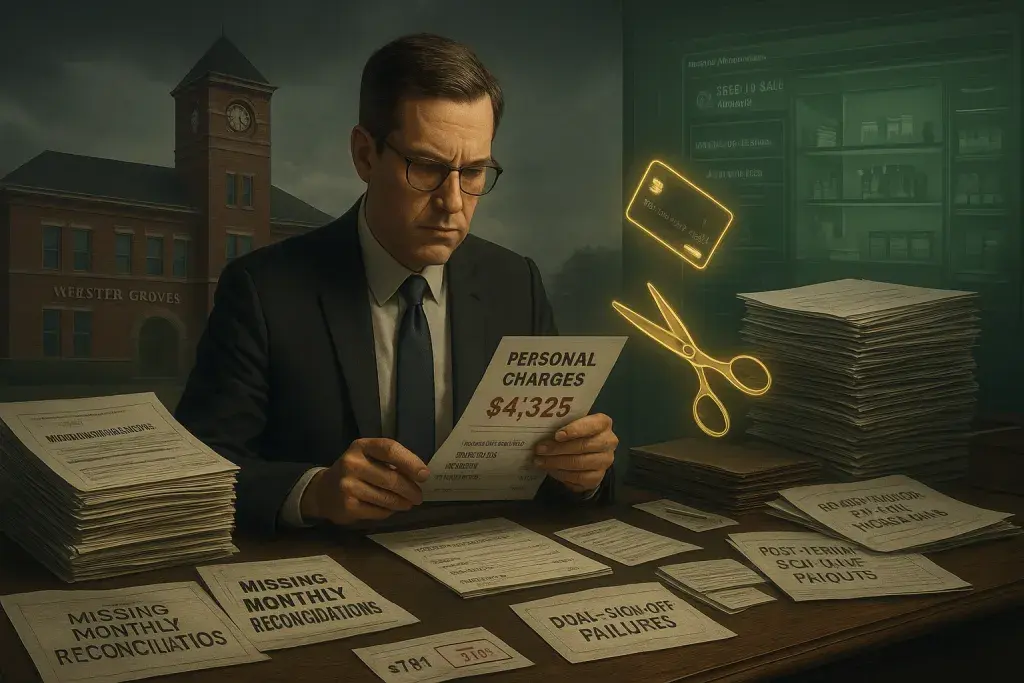
A state audit released Wednesday by Missouri Auditor Scott Fitzpatrick found that two former Webster Groves employees ran up more than $4,300 in personal charges on city-issued credit cards, including purchases at a marijuana dispensary, strip clubs and an Airbnb rental. The findings point less to a single bad actor and more to a system that simply wasn't watching the ledger closely enough.
That distinction matters for anyone who runs a regulated business where card transactions and compliance logs are supposed to tell a clean story. Dispensaries themselves operate under exactly the kind of scrutiny Webster Groves lacked internally - every sale tracked through seed-to-sale systems, every transaction reconciled against state reporting requirements. A cannabis retailer using a modern New York dispensary POS platform has to log purchases in ways that leave little room for the kind of unmonitored spending this audit uncovered in city government. The irony is hard to miss: a dispensary transaction shows up in the audit as evidence of misconduct, while the retailer that processed it was almost certainly operating under tighter transactional oversight than the municipality investigating it.
According to the report, an unnamed former city accountant made $884 in personal purchases between May and December 2024, including rideshare trips, a cannabis store charge and payments at "adult entertainment establishments." The employee has repaid $781 and still owes $103. Separately, the city's former finance director made 61 personal purchases totaling $3,522 between January and October 2025, logged internally as "Inadvertent Personal Charge" - a label that, on its face, does a lot of quiet work to soften what auditors describe as repeated, documented misuse.
Why Weak Card Controls Are a Universal Business Risk
Purchasing card abuse isn't unique to city halls. Any organization handling cash-adjacent transactions - and cannabis retail is very much in that category, given the sector's long-running friction with traditional banking - depends on layered controls: monthly statement review, receipt matching, dual sign-off on anomalies. Fitzpatrick's office found none of that functioning consistently in Webster Groves. Monthly purchasing card reports went unsubmitted for stretches of time, and nobody flagged it until finance staff noticed the gap themselves.
For cannabis operators, the lesson translates directly. Point-of-sale systems and inventory-tracking software exist precisely to prevent this sort of blind spot - mismatched batches, phantom voids, employee discounts that never get reviewed. A dispensary that treats its compliance logs as a formality rather than a working control document is exposed to the same kind of "brazen abuse," to borrow Fitzpatrick's phrase, that surfaced here. The fix isn't complicated in theory: reconcile statements promptly, require documentation before reimbursement, and suspend card access when reporting lapses. Webster Groves says it has now adopted that last measure, cutting off card access for employees who miss documentation deadlines.
The Personnel Fallout Adds a Second Layer
Beyond the card misuse, auditors found the city didn't follow its own personnel policies when the two employees departed. The finance director received sick leave pay after his resignation date; the former accountant was paid for 13 days after termination. No documentation supported either payout.
That's a separate failure from the spending itself, but it comes from the same root cause: policies existed on paper but weren't enforced in practice. Webster Groves says all improper charges have since been repaid, though the state's report lists $103 as still outstanding. Small discrepancy, but it's the kind of detail that matters when trust in an oversight process is already thin.