With thousands of international visitors expected to flood the New York metropolitan area this summer for a series of high-profile soccer matches at MetLife Stadium in New Jersey, the state's Office of Cannabis Management is running a public education campaign aimed squarely at tourists unfamiliar with New York's adult-use cannabis laws. The goal, according to OCM Executive Director John Kagia, is straightforward: steer visitors toward the licensed market, keep consumption legal and discreet, and prevent adverse events that could put a political target on an industry still working to establish its footing. For dispensary operators, this is both an opportunity and a compliance stress test.
New York currently has more than 200 licensed cannabis dispensaries operating in and around New York City - a number that represents hard-won regulatory progress after a slow and litigation-plagued rollout. What makes this tourism window distinct is the sheer concentration of first-time cannabis consumers and international visitors who come from countries where cannabis remains fully prohibited. Operators in other legal states have learned this lesson before New York did: unfamiliar consumers default to convenience, which often means unlicensed sellers, street-level transactions, or gray-market delivery apps. Dispensaries with strong delivery infrastructure and clear point-of-sale workflows are better positioned to capture that demand compliantly. The parallel matters even in adjacent markets - states like Maryland, where systems such as pos cannabis maryland help licensed retailers manage inventory, compliance logs, and customer flow, have shown that operational readiness at the retail level is what separates licensed operators who capture tourist volume from those who don't.
The OCM's campaign centers on a simple but meaningful compliance signal: the state-issued license sticker affixed to the front door or window of a licensed dispensary. Kagia has been explicit - products sold through illegal shops are not subject to state testing protocols, and there is no certificate of analysis backing what ends up in the consumer's hands. That matters because unlicensed cannabis in New York has been found to contain undisclosed additives and contaminants. This is not a theoretical risk. It is the kind of product-safety gap that can produce emergency room visits and, politically, ammunition for prohibition advocates. Licensed operators have a clear, legitimate differentiator here: state-tested, compliant product, proper labeling, and accountability at the point of sale.
What Dispensary Operators Are Actually Doing
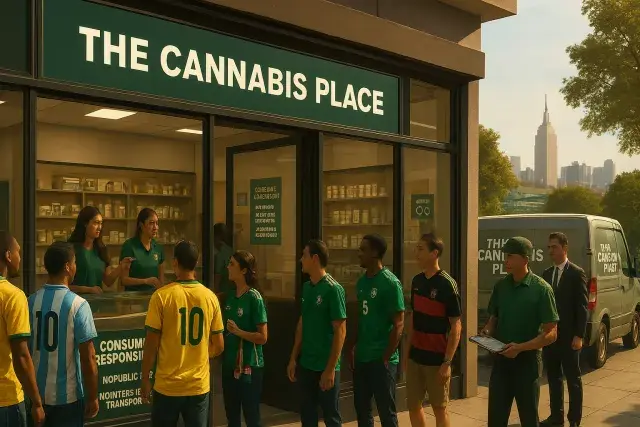
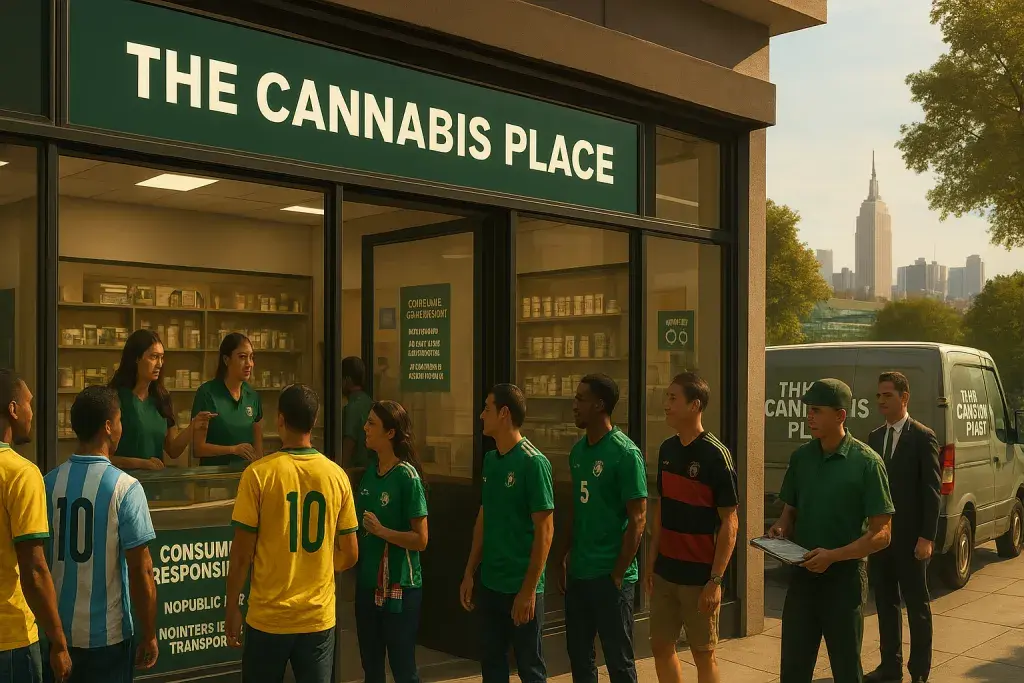
Some licensed retailers are moving beyond passive compliance and treating the tourism surge as a concrete revenue opportunity. Osbert Orduna, CEO of The Cannabis Place - which operates locations in Middle Village, Queens, and Jersey City, NJ - told the New York Post his business is running promotional events, including watch parties in a VIP lounge, and offering a "special gift" to customers who arrive wearing their home country's jersey. That's a straightforward retail promotion, but it also illustrates a real operational challenge: driving compliant foot traffic, managing budroom capacity, and keeping POS systems moving efficiently when consumer volume spikes unpredictably. Dispensaries that haven't stress-tested their staffing models and point-of-sale throughput before peak weeks may find themselves understaffed at exactly the wrong moment.
Delivery is the other dimension worth watching. Tourism doesn't concentrate in dispensary neighborhoods - it spreads across hotels, short-term rentals, rooftop gatherings, and private events. Licensed dispensaries with active delivery operations and optimized delivery manifest workflows stand to reach consumers who would otherwise never find a storefront. The catch is that delivery compliance in New York is operationally demanding: manifest documentation, age verification at the door, and real-time inventory reconciliation are non-negotiable. Operators who treat delivery as a compliance afterthought rather than a structured fulfillment channel will struggle to scale it safely.
Consumption Rules Visitors Won't Know Without Being Told
New York prohibits cannabis consumption in any location where tobacco smoking is also prohibited - which covers most public venues, parks subject to specific rules, and any venue hosting minors. This is not a nuanced interpretation of the law; it is the law, and it applies equally to international visitors. Kagia has been direct about the concern: watch parties will draw families with children, and consumption at those events creates both a legal exposure and a community relations problem for the broader industry. Here's the operational implication for licensed retailers - staff at the point of sale bear some responsibility for that education. A brief verbal reminder about public consumption rules, integrated into the retail interaction, is both good practice and consistent with the kind of responsible retailing that regulators want to see.
There is also the matter of interstate transport. Federal law prohibits carrying cannabis across state lines, including by air. For a metropolitan area served by three major airports and drawing visitors from countries with no legal cannabis market, that restriction is easy to miss and carries real consequences. Operators should consider clear, simple in-store signage on this point - not because it is required, but because an international visitor arrested at JFK with a New York dispensary bag in hand is a story no licensed retailer wants to be part of.
The Broader Market Signal for Operators
The framing from proponents - that a major international tourism event could serve as a broad introduction to New York's legal cannabis market - is reasonable in principle. What it actually requires, though, is that the licensed industry perform well: product quality, retail experience, clear compliance communication, and no adverse events that make the evening news. That's a higher bar than it sounds, particularly for an industry still managing SKU inventory across a fragmented wholesale market, navigating a complex excise tax structure, and operating largely without access to standard banking and card payment infrastructure. Cash-heavy operations under high consumer volume are operationally and security-risk-prone. Operators who haven't addressed payment workflow - including cashless ATM options or compliant debit solutions where available - may find the revenue opportunity harder to capture cleanly than it looks on paper.
The OCM's education push is well-intentioned and practically necessary. But the real work happens inside the store, at the POS terminal, on the delivery route, and at the front counter where a budtender explains to a first-time international visitor what a certificate of analysis is and why it matters. That's where legal market differentiation either holds or doesn't.