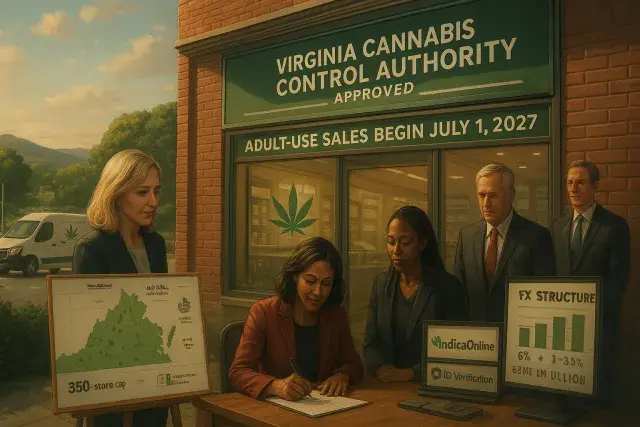
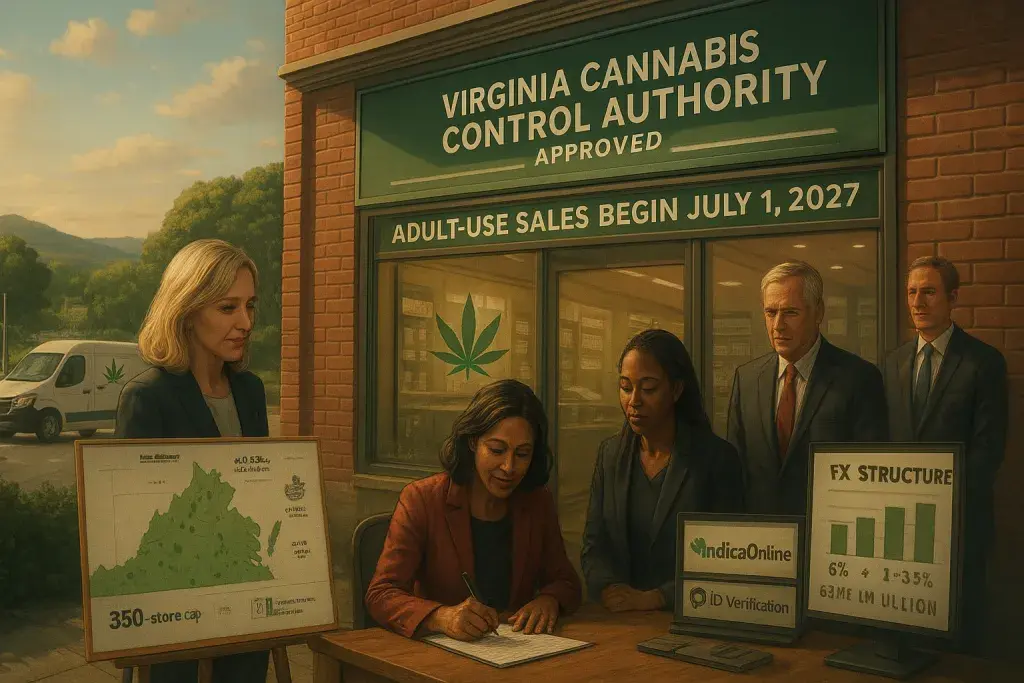
Virginia has a retail cannabis market on the books - finally. State budget legislation signed June 29 authorizes regulated adult-use sales to begin July 1, 2027, capping a years-long gap in the state's cannabis policy that left adults legally permitted to possess cannabis but with nowhere licensed to buy it. The framework sets a 350-store cap, directs the Virginia Cannabis Control Authority to open license applications February 1, 2027, and establishes a tax structure designed to make legal purchasing competitive with the illicit market.
The timeline matters for operators planning market entry. Virginia has been in a possession-only holding pattern since 2021 - when it became the first Southern state to legalize adult possession and home cultivation - but without a retail framework to match. That gap created precisely the kind of gray-market pressure regulators elsewhere have struggled to reverse. States that have built functioning adult-use programs, from Oregon to Colorado, have generally found that tax policy and licensing velocity determine how quickly consumers shift away from unlicensed sources. Operators in mature markets have relied on purpose-built retail infrastructure - point-of-sale compliance tools, seed-to-sale tracking integration, delivery manifest management - to stay audit-ready from day one. Tools like IndicaOnline dispensary software in Oregon offer a useful reference point for what compliant dispensary operations look like in a regulated adult-use environment, particularly for operators now evaluating Virginia's incoming framework.
Governor Abigail Spanberger had vetoed an earlier standalone retail bill before reaching a compromise with Sen. Lashrecse Aird and Del. Paul Krizek - embedding the adult-use framework directly into the state budget. That's not a minor procedural detail. Placing the framework in budget legislation gave it a different path to enactment and made it harder to block piecemeal. Former Governor Glenn Youngkin had vetoed a retail bill in 2024, so the legislative maneuvering here was deliberate.
Tax Structure Built to Pull Consumers Into the Legal Market
Virginia's opening excise tax rate of 6% is modest by adult-use standards. It is scheduled to rise to 8% on July 1, 2029. Local governments can layer on an additional 1% to 3.5% cannabis tax, and standard sales and use taxes also apply. A Senate Finance and Appropriations Committee briefing estimated the combined effective rate at 12.3% to 16.5%, depending on locality - a real spread that operators will need to factor into wholesale pricing and retail margin modeling before selecting a location.
Sen. Aird framed the lower starting rate explicitly as a market-capture strategy. "If our goal is to move consumers away from the illicit market, the legal market has to be able to compete, and keeping the tax rate low is not just an economic decision," Aird said. "It is a public safety strategy." That framing is consistent with how most cannabis economists and regulators have analyzed illicit-market persistence: tax-burdened legal products struggle to compete on price, particularly in early market phases. California's experience - where high excise taxes and local licensing bottlenecks have sustained a large unlicensed market for years - is the cautionary reference point most state policymakers now cite when setting rates.
The state estimates cannabis taxes and related revenue will generate roughly $51 million in the first year. That revenue is allocated to early childhood and K-12 education, behavioral health programming, public health programs, and the Cannabis Equity Reinvestment Fund.
Licensing Framework: Caps, Conversions, and Microbusinesses
The 350-store cap will not roll out all at once. The Cannabis Control Authority controls licensing cadence and rulemaking, which means the actual pace of store openings will depend on how the CCA structures its application windows and review timelines - details that have not yet been published. Operators planning to enter the market will need to track CCA rulemaking closely between now and the February 2027 application opening.
Existing medical cannabis pharmaceutical processors have a defined conversion path. They can enter the adult-use market through dual-use privileges, provided they meet licensing requirements, demonstrate that medical patient access is preserved, and pay a one-time $10 million conversion fee - or enter an approved installment plan - by May 1, 2027. That fee is substantial. For vertically integrated operators with established dispensary footprints, the math may still favor conversion. For smaller medical operators, it is a real barrier.
Del. Krizek secured authority for the CCA to issue up to 100 microbusiness licenses by May 1, 2027. That provision is aimed at preventing the market from consolidating immediately around the most heavily capitalized applicants - a dynamic that has frustrated equity advocates in several other states where early license rounds defaulted to operators with the deepest legal and financial resources. How the CCA defines microbusiness eligibility in rulemaking will determine whether that 100-license carve-out functions as intended.
Delivery services are permitted under the framework, which is operationally significant. Delivery adds compliance complexity - vehicle manifests, driver verification protocols, geo-fencing requirements - but it also expands addressable customers in markets where retail density is limited by the store cap.
Compliance Requirements Operators Should Understand Now
Virginia's framework includes several compliance provisions with direct operational weight. Among them:
- Retail stores must be located at least 1,000 feet from schools, hospitals, playgrounds, and drug treatment facilities - a siting restriction that will constrain real estate options, particularly in urban markets
- Adult-use serving sizes are capped at 10 mg THC, with package limits of 100 mg THC - parameters that will affect SKU development, packaging design, and product sourcing for brands and manufacturers entering the market
- Escalating penalties apply to retailers that fail to conduct required ID checks - consistent with the age-verification standards common across regulated adult-use states
- The possession limit for adults increases from 1 ounce to 2 ounces
- The civil fine for public cannabis consumption rises from $25 to $250 beginning July 2027
- Oversight of intoxicating hemp products transfers from the Virginia Department of Agriculture and Consumer Services to the CCA, with the 25:1 CBD-to-THC ratio provision eliminated
That last point deserves attention. Virginia's hemp regulatory transfer reflects a broader national pattern: as intoxicating hemp-derived products - delta-8, delta-9, and related compounds - have proliferated through unlicensed retail channels, states have moved to bring them under cannabis regulatory authority. Eliminating the 25:1 ratio and shifting oversight to the CCA means hemp-derived product businesses operating in Virginia will face a different compliance environment. Some will adapt; others will exit.
The enforcement architecture also includes a public licensee registry, an anonymous tip line for reporting illicit activity, and expanded oversight of ownership and financial interests. These are standard tools in mature regulated markets, but they carry a practical reminder: beneficial ownership disclosures, investment structures, and management agreements need to be documented carefully and kept current. Regulatory audits that surface undisclosed financial interests have caused license revocations in other states - Virginia's framework appears built to catch exactly that.
The broader point is this: Virginia is not a blank-slate market. It has a medical program, a licensed operator base, an established regulatory agency, and years of deferred legislative tension baked into its politics. The 2027 launch gives operators roughly 18 months to prepare - for licensing, real estate, compliance systems, staffing, and supply chain relationships. That is enough time to do it right, and not enough time to improvise.