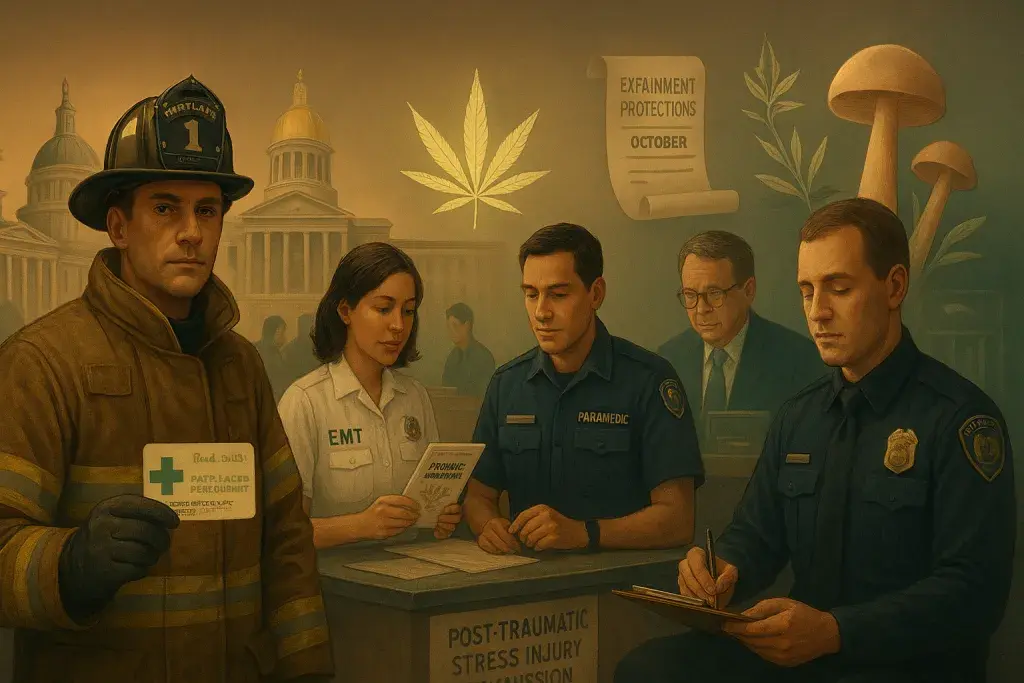
A quiet but meaningful shift is underway in how states approach mental health coverage for first responders - and cannabis policy is increasingly part of that conversation. This year, several legislatures moved to expand access to emerging therapies, protect medical cannabis patients from workplace discrimination, and fund treatment programs specifically designed for firefighters, paramedics, and law enforcement officers carrying the psychological weight of repeated trauma. The moves signal that regulated cannabis and experimental mental health treatments are no longer fringe considerations in public safety policy; they are becoming part of the mainstream legislative agenda.
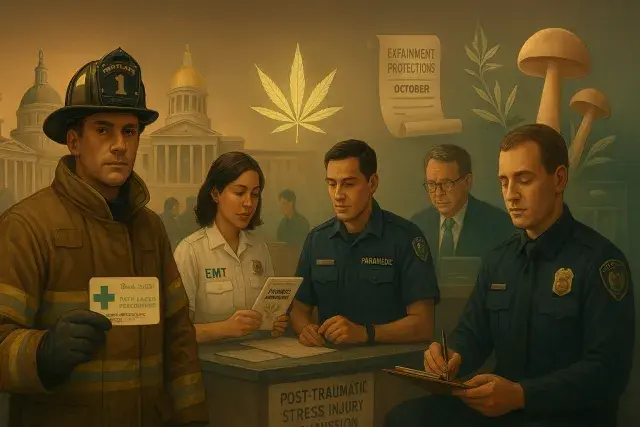
For dispensary operators and compliance professionals tracking medical cannabis programs, Maryland's new employment protection law is the provision most worth watching. Effective October, the law shields registered medical cannabis patients who work as firefighters, EMTs, paramedics, and other rescue personnel from employment discrimination when they test positive for cannabis metabolites off duty - provided they are not impaired while on the job. The distinction matters enormously from a compliance standpoint. It codifies a line that employers and regulators have long struggled to draw: the difference between a positive metabolite test, which can reflect prior use, and actual impairment at work. Operators running a cannabis retail platform for Massachusetts or any adjacent state with medical cannabis programs should recognize the broader implication here - employment protection laws reshape who walks through a dispensary's door and how those patients expect their purchases to be treated by their employers, which in turn affects product selection, dosing education, and documentation practices at the point of sale.
The workplace protection angle is only one piece of this story. Ohio Gov. Mike DeWine, a Republican, signed legislation creating a Post-Traumatic Stress Injury Commission charged with reviewing applications from eligible first responders seeking assistance covering treatment costs. That commission will need to define, in practice, which therapies qualify - and that definition will carry real weight as psilocybin-assisted therapy and other emerging modalities move closer to clinical legitimacy. Connecticut expanded a Yale University pilot program studying psilocybin-assisted therapy to allow any state resident 18 or older who meets the institutional review board's clinical criteria to participate, having previously limited enrollment to veterans, retired first responders, and frontline health care workers. That's a meaningful expansion of scope, even if the program remains research-bound.
Psychedelics Enter the Policy Conversation - Carefully
Missouri lawmakers advanced a bill earlier this year that would allow veterans and first responders in approved research studies to receive psilocybin and ibogaine under medical supervision for PTSD and related mental health conditions. The legislature adjourned in May before the bill could reach the governor's desk - fair enough, as these things go - but the fact that it moved at all reflects how quickly the conversation has shifted. Ibogaine, derived from an African plant, remains a Schedule I controlled substance federally. Psilocybin carries the same federal classification. The research carve-out model these bills rely on is essentially borrowed from the playbook cannabis advocates used for years: build an evidentiary record inside a tightly controlled clinical environment before pushing for broader access.
What's striking here is the institutional credibility attached to these programs. Yale's involvement in Connecticut lends scientific weight that early medical cannabis programs rarely had when they launched. That credibility matters for legislative durability. It also matters for the industries adjacent to these programs - laboratory testing infrastructure, compliance software, patient registry systems - all of which need clear regulatory frameworks before they can serve a new class of therapeutic patients at scale.
What This Means for Licensed Cannabis Operations
The practical business implication for dispensary operators is less about psychedelics - those programs remain firmly in research settings - and more about the normalization of non-traditional therapies in state mental health policy. Maryland's employment protection law, for instance, directly affects how medical cannabis dispensaries should think about patient counseling and recordkeeping. A registered patient who is also a first responder now has statutory protection in Maryland, but that protection depends on the patient being lawfully registered and not impaired on the job. Budtenders, patient care consultants, and compliance staff need to understand that context when serving this population - not to make medical claims, but to accurately explain what lawful use means under state law and what documentation exists to support a patient's registration status.
More broadly, these legislative moves reflect a slow but real shift in how state governments view medical cannabis: less as a marginal alternative and more as a recognized component of a patient's broader health management. That shift creates both opportunity and compliance pressure. The opportunity is a more stable, less stigmatized patient base. The pressure is that legal frameworks around employment, impairment testing, and patient privacy are growing more complex - and dispensary operators who don't track those changes will find themselves unprepared when a patient's employment situation intersects with their purchase history or registry status.
The Regulatory Momentum Is Real, but Uneven
None of these state moves amount to federal reclassification or blanket decriminalization. They are targeted, incremental, and in several cases still incomplete - Missouri's bill didn't cross the finish line; Connecticut's expansion is tied to a university IRB; Ohio's commission still has to stand up and begin operations. That unevenness is the norm in cannabis-adjacent policy. States move at different speeds, through different political coalitions, and with different definitions of what counts as legitimate treatment.
For the B2B operators - the compliance software vendors, the point-of-sale providers, the seed-to-sale tracking companies serving medical programs - the takeaway is to watch Maryland closely as the October implementation date approaches. Employment protection laws for medical cannabis patients in safety-sensitive professions set a precedent that other states will either follow or actively reject, and either outcome reshapes the regulatory environment these businesses operate in. The industry has seen this pattern before: one state's experiment becomes another state's statute. The timeline compresses faster than most operators expect.