
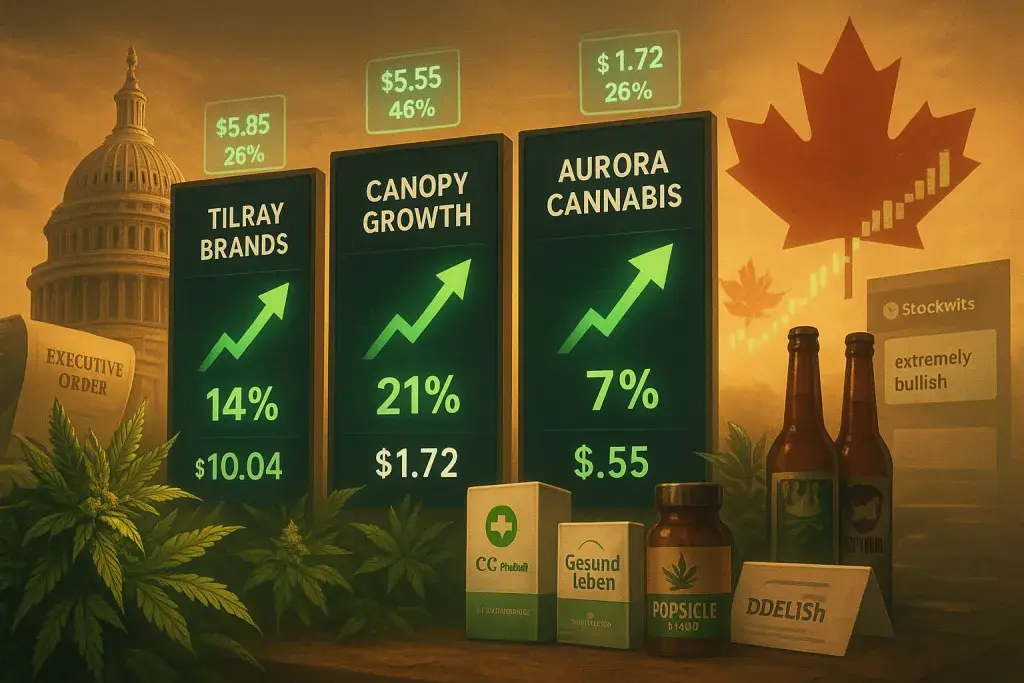
A single regulatory headline moved markets on Wednesday in a way that years of incremental reform never quite managed to. Reports that the U.S. may reclassify marijuana out of Schedule I - the most restrictive federal drug category, currently shared with heroin and LSD - sent shares of Tilray Brands, Canopy Growth, and Aurora Cannabis sharply higher. TLRY gained 14%, CGC surged 21%, and ACB added 7% in a single session. For an industry that has spent years grinding against federal intransigence, the reaction was immediate and emphatic.
The potential rescheduling - reportedly moving cannabis into a lower-risk category alongside substances like ketamine and testosterone - follows a December executive order directing regulators to review federal marijuana restrictions. The distinction matters more than it might appear on the surface. Remaining in Schedule I doesn't just carry stigma; it shapes everything from banking access and insurance eligibility to research permissions and interstate commerce. For U.S.-focused operators, tax exposure under Section 280E of the federal tax code is perhaps the most immediate pain point - that provision bars businesses trafficking in Schedule I or II substances from deducting ordinary business expenses, a burden that has squeezed dispensary margins for years. Operators deploying point-of-sale for Maryland dispensaries and other state-licensed retailers understand this cost pressure intimately, since compliance-heavy markets require sophisticated inventory and reporting infrastructure even as tax rules chip away at profitability. A rescheduling wouldn't automatically resolve 280E - that would require separate legislative or regulatory action - but it would represent the most concrete federal acknowledgment yet that cannabis policy is changing.
Among the three Canadian producers, Aurora Cannabis carries the widest implied upside based on current analyst price targets. Consensus estimates compiled by Koyfin put Aurora's 12-month average target at $5.55, representing roughly 46% upside from current levels. Aurora holds one Strong Buy, two Buy, and two Hold ratings across five covering analysts. Tilray Brands comes in second, with an average target of $10.04 implying about 28% upside, though its ten-analyst coverage includes a Strong Sell - a reminder that even in a rally, conviction is uneven. Canopy Growth's average target of $1.72 suggests approximately 26% upside from current levels, with similar analyst division. None of these targets, to be clear, are guarantees; they reflect sentiment at a snapshot in time, and cannabis stocks have a documented history of reacting hard to regulatory headlines and then retracing.
Three Producers, Three Bets on What Comes Next
What's striking here is how differently each company is positioning itself for a regulatory environment that remains genuinely uncertain. Tilray has diversified aggressively - acquiring U.S. BrewDog assets, launching Popsicle Hard beverages through a partnership with The Magnum Ice Cream Company, and deepening its medical cannabis distribution in Germany through CC Pharma, 14U Pharma, and the Gesund leben pharmacy network. The strategy is essentially a hedge: if U.S. federal reform accelerates, Tilray has existing consumer packaged goods infrastructure and brand recognition that could translate into an adult-use or wellness play. If it doesn't, the alcohol and medical channels carry their own revenue.
Canopy Growth is taking a more concentrated approach. It launched the Deelish value brand targeting the domestic Canadian retail market - a direct bid for shelf space in a segment where price sensitivity among consumers is real - and agreed to acquire MTL Cannabis in a C$125 million transaction. MTL was reportedly adjusted-EBITDA-positive at the time of the deal, which matters in a sector where profitability has often been elusive. Canopy's focus on strengthening its Canadian base suggests the company sees durable value in a mature regulated market, even without immediate U.S. federal access.
Aurora, meanwhile, is leaning hard into international medical cannabis - expanding across Australia and New Zealand, securing EU plant variety rights for proprietary cultivars, and launching the Daily Special medical cannabis brand in Germany. That export-led strategy aligns Aurora with markets where medical cannabis is legal and regulated at the national level, giving the company a revenue base that doesn't depend on U.S. federal action at all. In that sense, Aurora's upside potential may be less about rescheduling and more about execution in markets where it already has legal footholds.
Retail Sentiment Is Running Hot - Which Is Worth Watching
On Stocktwits, retail sentiment for all three stocks registered as extremely bullish amid extremely high message volume following Wednesday's news. That kind of retail enthusiasm can push a momentum trade further than fundamentals alone would justify - and it can reverse just as quickly. Over the past year, Tilray shares have climbed 72% and Canopy has gained 17%, while Aurora has declined 11%. Wednesday's rally compressed a lot of expectation into a single session.
For operators and B2B participants in the cannabis supply chain, the more durable question isn't whether these stocks hold their Wednesday gains. It's whether rescheduling - if it actually happens - changes the operating conditions that licensed businesses face every day: tax treatment, banking availability, payment processing limitations, and the patchwork compliance requirements that vary by state. Those structural constraints don't dissolve overnight with a scheduling change. They require separate regulatory, legislative, and banking-sector responses. The stocks moved. The underlying business environment will take considerably longer to catch up.