Municipalities across Ohio are now receiving their first meaningful distributions from the state's adult-use marijuana excise tax - and the funds are landing in general accounts, capital plans, and park budgets in amounts that local officials are taking seriously. Ohio collected approximately $33 million in adult-use marijuana excise tax revenue between July 2024 and November 2025, and the Ohio Department of Taxation began pushing those dollars to host communities in January under a framework created by Senate Bill 56. For dispensary operators doing business in Ohio, this is more than a civic footnote. It signals that the host-community relationship has moved from political negotiation to a functioning revenue channel - one that local governments are already building into long-term budget assumptions.
The mechanism behind the distributions is straightforward: SB 56 established the Host Community Cannabis Fund and directs 36% of Ohio's adult-use marijuana excise tax - set at 10% under Issue 2, which voters approved in 2023 - to the municipalities where licensed dispensaries operate. That structure matters operationally. Dispensary owners in states like Maine, where operators rely on tools such as a cannabis pos system maine to capture detailed transaction-level data across their retail floors, understand that what gets reported at the point of sale flows directly into excise tax calculations at the state level. The accuracy of that data has downstream consequences - not just for compliance audits, but now, in Ohio's case, for the checks that municipalities actually cash. A reporting discrepancy at the register isn't merely a compliance problem; it affects the host-community allocation formula itself.
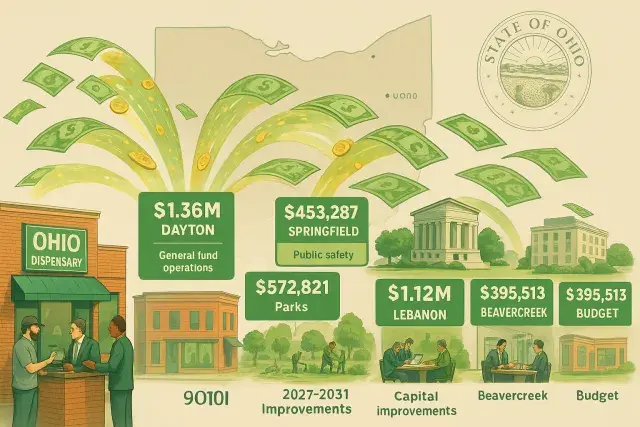
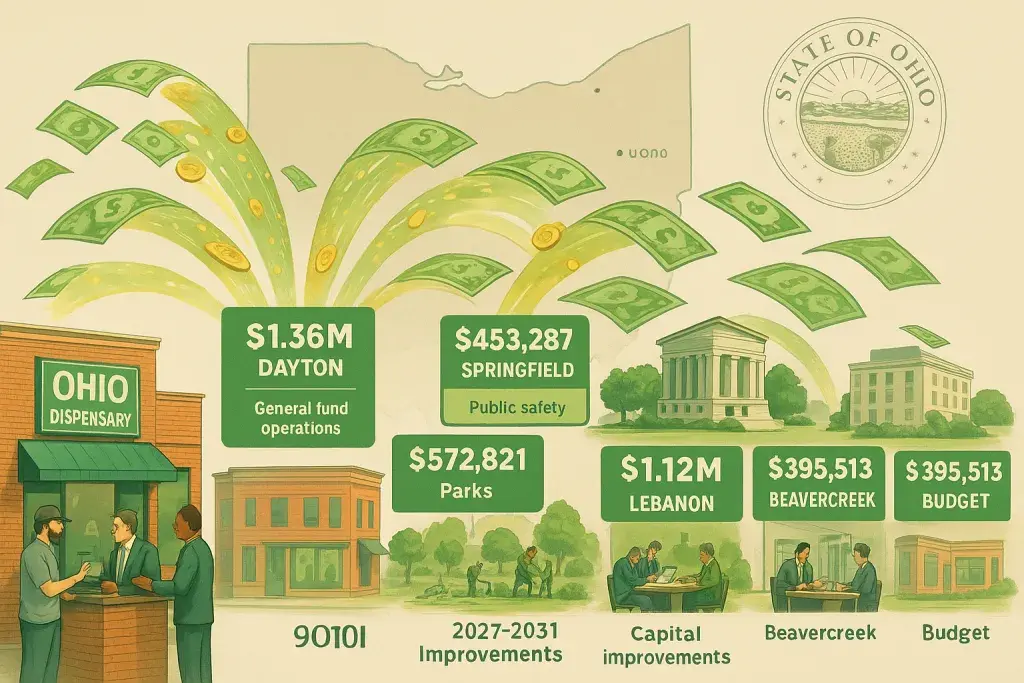
Dayton has received the largest share in the Miami Valley region - $1.36 million as of April - which the city is directing into general fund operations. Springfield has collected approximately $453,287 through the same period, with more than 57% of its general fund expenditures committed to public safety services. Piqua has committed its $572,821 share explicitly to parks maintenance and improvement. Monroe, sitting at more than $1.12 million received, is weighing how to fold the revenue into a 2027-2031 Capital Improvement Plan. Lebanon is planning a property tax holiday in 2027, partly supported by cannabis distributions that are currently running between $22,000 and $25,000 per month. That's a functioning revenue stream, not a one-time windfall.
The January Catch-Up Payment Skewed Early Perceptions
Several municipal officials noted that the first distribution in January was substantially larger than subsequent monthly payments - because it included a retroactive allocation covering tax collections from the launch of recreational sales through the end of 2024. That kind of catch-up payment is common in newly structured excise programs, and it matters for how operators and local governments should read early distribution figures. The January number wasn't a run-rate signal. Cities receiving $80,000 in the first check and $22,000 in subsequent months aren't seeing a decline in sales activity; they're seeing the normalization of a monthly allocation cycle after an initial backlog cleared. Dispensary operators should understand this distinction if they're fielding questions from local economic development staff about sales performance.
Real Money, But Not a Fix for Structural Fiscal Shortfalls
Here's the catch, though - and Springfield's budget spokeswoman said it plainly. Cannabis tax distributions do not come close to offsetting the cumulative fiscal damage local governments have absorbed from years of reductions in state-shared revenues and shifts in local government funding structures. Beavercreek, which has received approximately $395,513 to date, is simultaneously grappling with budget pressures serious enough that voters will consider a 1% municipal income tax this November. The cannabis revenue goes into the general fund. It helps. It doesn't solve the underlying problem.
For dispensary operators, this matters for reasons beyond civic goodwill. A host community under fiscal stress is a host community that may revisit zoning approvals, conditional-use permits, or local operational requirements more aggressively than one operating from a position of budget stability. The relationship between a licensed cannabis business and the municipality that permitted it isn't static. Cannabis revenue flowing into a city's budget creates a financial interdependency - one that can work in an operator's favor over time, or generate friction if expectations aren't managed. Operators who treat host-community compliance as a checkbox rather than an ongoing relationship tend to discover that distinction the hard way.
What This Model Signals for Dispensary Operations in Regulated States
Ohio's host-community fund structure reflects a regulatory philosophy that's gained traction in several adult-use markets: localities that accept the operational and community impact of licensed cannabis retail should receive a direct share of the tax revenue those businesses generate. That's a different model from states where all excise revenue flows to a central state fund and local governments receive little or nothing. The difference shapes how municipalities approach permitting, local caps on dispensary licenses, and the degree to which they support - or oppose - additional retail locations.
For multi-state operators assessing Ohio's market or evaluating new license applications, the practical implication is that the host-community financial relationship is now quantifiable. When a city like Monroe is sitting on $1.12 million in cannabis revenue and actively incorporating it into a five-year capital plan, that city has a measurable stake in the continued operation of the dispensary generating those dollars. That's a different risk profile than operating in a municipality that views licensed cannabis retail with indifference or quiet hostility. It doesn't eliminate compliance obligations - state-level seed-to-sale tracking, METRC reporting, packaging and labeling requirements, and age verification protocols remain non-negotiable regardless of local reception - but it does change the political operating environment in ways that affect long-term licensing stability.
Ohio's adult-use market is still relatively young. The revenue figures will grow as the retail base matures and consumer purchasing patterns stabilize. The host-community fund is already creating a constituency of local governments with a direct financial interest in that growth. That's not a guarantee of anything. But it's a structurally different relationship than most regulated industries ever manage to build with the municipalities that host them.