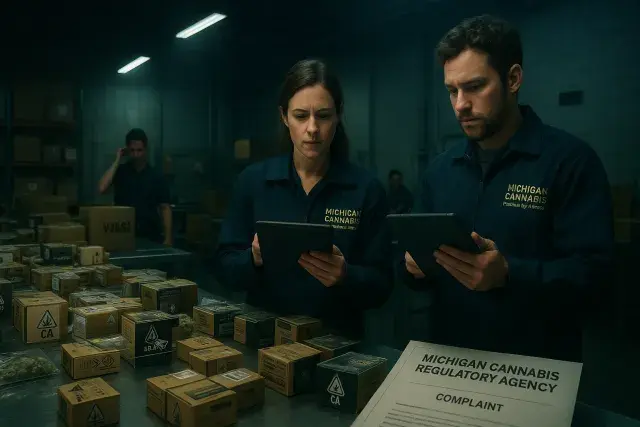
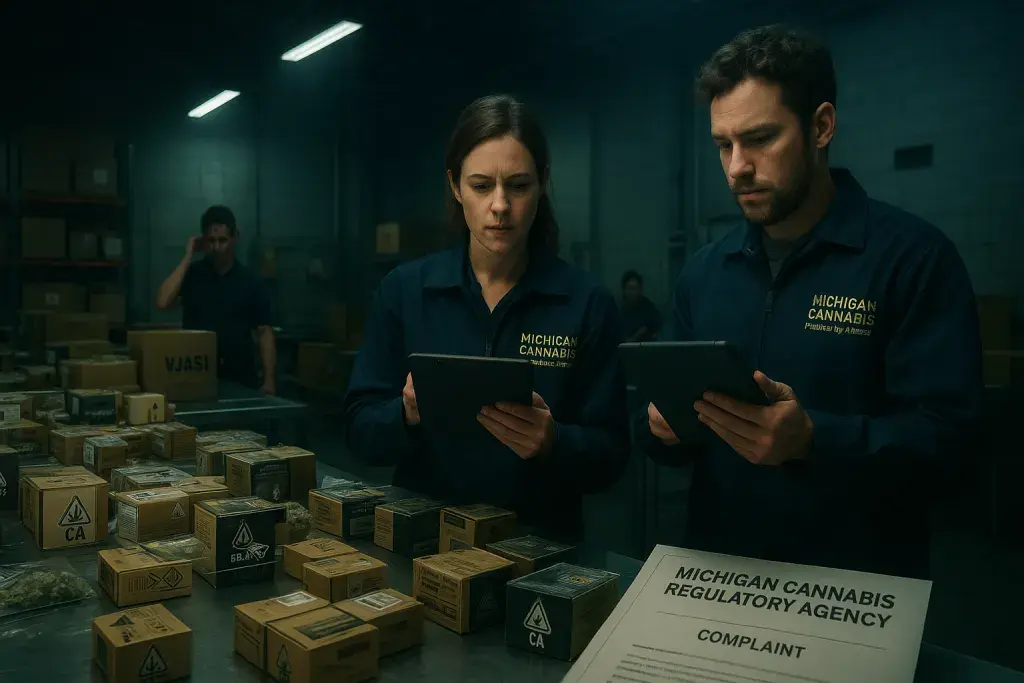
A Michigan cannabis processor is facing serious regulatory exposure after state inspectors found more than 12,000 individual cannabis products at its Harrison Township facility that lacked Metrc tags or any other identifying information - and some of those products appeared to have come from California. The Michigan Cannabis Regulatory Agency filed a formal complaint against VJAS 1, and the company now faces potential fines, license suspension, revocation, restriction, or refusal of renewal. In a seed-to-sale tracking system, finding thousands of untagged units at a licensed facility is not a paperwork problem. It's a fundamental breakdown of the compliance infrastructure the entire regulated market depends on.
What makes this case particularly striking is the layering of violations uncovered in a single inspection. Beyond the sheer volume of untagged product, investigators found items in California-specific packaging - bearing "CA" markings and California-mandated warning language - sitting inside a Michigan-licensed processing facility. Employees reportedly could not explain how or why the products were there. That's a significant detail. Compliance officers at well-run facilities maintain chain-of-custody documentation precisely so that question never goes unanswered. Operators in other states tracking this case - including those evaluating their own back-of-house systems with tools like a dispensary pos maryland solution - should note how quickly an unexplained inventory gap can escalate from an administrative flag to a license-threatening complaint. When investigators cross-referenced the Metrc tags that were present, they discovered those tagged products were recorded as being located at entirely different licensed businesses. That's not a clerical error. That's a material discrepancy in the state's track-and-trace system.
Why Metrc Integrity Is Non-Negotiable
Metrc - the Marijuana Enforcement Tracking Reporting and Compliance system - functions as the backbone of cannabis inventory accountability in Michigan and more than two dozen other states. Every product batch, every transfer, every sale is supposed to generate a corresponding Metrc tag and log entry. The system exists specifically to prevent diversion: keeping unregulated, untested, or out-of-state product from entering the licensed supply chain under the cover of a legitimate facility's license.
When a processor holds thousands of units with no tags, the state has no way to verify where those products came from, whether they were tested, what they contain, or where they were headed. From a consumer safety standpoint, that's the worst-case scenario the regulatory framework is designed to prevent. Untracked cannabis products have no verified lab testing history, no certificate of analysis, and no documented chain of custody - meaning there's no assurance that what's in the package matches what any label claims.
The presence of California-packaged product inside a Michigan processor is a separate but compounding problem. Interstate cannabis commerce remains federally illegal. A licensed Michigan business receiving, holding, or distributing product from another state's supply chain exposes itself - and potentially its downstream wholesale partners - to risks that go well beyond a state licensing board. The facility cannot claim the product is compliant simply because it arrived in compliant-looking packaging from a regulated market.
The Compliance Infrastructure Gap This Case Exposes
VJAS 1's situation highlights an operational risk that exists across the licensed cannabis industry, not just in Michigan. Processors and retailers that grow quickly, change ownership, or operate with inadequate inventory management systems can accumulate compliance liabilities faster than their internal teams recognize them. Twelve thousand untagged units don't appear overnight in a single transaction - that kind of accumulation points to systemic inventory control failures: receiving product without logging it, failing to reconcile physical counts against Metrc records, or simply not auditing the floor regularly against compliance logs.
Licensed operators should treat this case as a practical prompt to audit their own facilities now, rather than during a regulatory inspection. The questions worth asking are straightforward: Can every product on-site be traced to a Metrc entry? Are physical inventory counts reconciled against the system on a defined schedule? Does the receiving team verify tags at intake - every time? Are there products anywhere in the facility that staff cannot immediately account for?
The thing is, most state inspectors aren't looking for reasons to file complaints. But when an inspection turns up thousands of untagged units and employees can't explain them, the agency has little choice but to treat that as a serious compliance failure - because it is one.
What Operators Elsewhere Should Take Away
License revocation or suspension doesn't just end a business. It affects wholesale relationships, employees, and any investors or landlords connected to the operation. For multi-location operators or businesses with multiple license types, a complaint at one facility can trigger review of the entire portfolio. And in a state like Michigan, where the licensed adult-use market is competitive and the CRA has shown a consistent willingness to pursue enforcement actions, the margin for inventory irregularities is thin.
The VJAS 1 case is, at its core, a track-and-trace failure - but it's also a reminder that the seed-to-sale system only works if every participant in the supply chain treats it as mandatory infrastructure, not administrative overhead. Regulators built these systems because diversion is a real and ongoing problem in licensed cannabis markets. When a facility can't account for its own inventory, it undermines the credibility of the licensed market as a whole.