Jay Grundy put $350,000 against a 10-year note in 2025 to expand his hemp operation in Marion County, Kentucky. A year into repayment, a provision tucked into the FY2026 Agriculture appropriations bill by Sen. Mitch McConnell could wipe out the market that makes those payments possible. The measure would impose a nationwide prohibition on many hemp-derived products - full spectrum CBD, delta-8, delta-9, and others - that have operated for years under what's become known as the "intoxicating hemp loophole" opened by the 2018 Farm Bill.
A Legal Market Built on a Statutory Gap
The 2018 Farm Bill legalized hemp federally, defining it as cannabis with no more than 0.3% delta-9 THC by dry weight. What it didn't fully anticipate was the rise of a supply chain built around converting legal hemp into intoxicating cannabinoids - delta-8, delta-9 derived from hemp extraction, and other synthesized compounds - sold at retail with none of the licensing, excise tax, or seed-to-sale tracking that state-regulated adult-use cannabis programs require. That regulatory asymmetry is exactly what critics point to. It's also exactly what growers like Grundy have built their business models around, legally, under current federal law. Close the loophole at the appropriations-bill level, without a transition period or a replacement regulatory framework, and an entire tier of farmers and processors loses its primary buyer overnight.
What's at Stake on the Ground
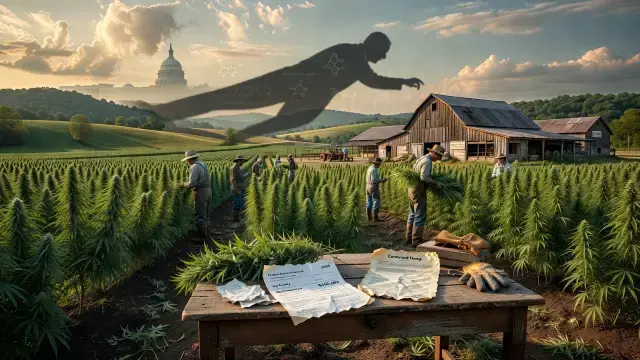
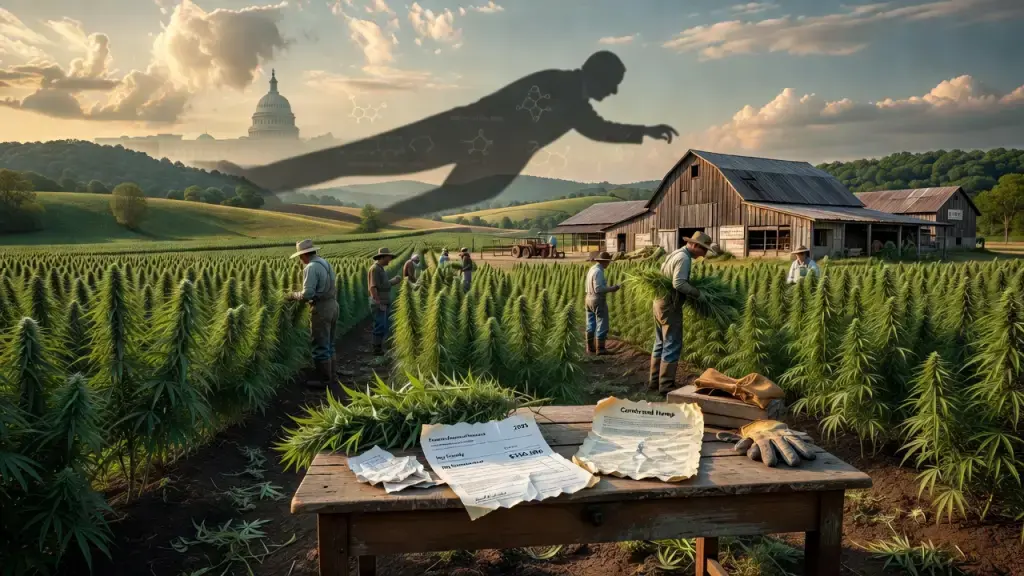
Grundy's 305-acre farm sits on land that, a century ago, would have gone to tobacco. Kentucky once produced close to three-quarters of the nation's hemp-based fiber before the Controlled Substances Act of 1970 classified hemp alongside marijuana and effectively ended the trade. The state's hemp program only came back after the 2014 Farm Bill, regulated through the Kentucky Department of Agriculture. Grundy now farms exclusively for Cornbread Hemp, and his operation supports eight visa-based agricultural workers, local hires, a maintenance crew, and leased barn space across roughly 20 neighboring properties - barns that once cured tobacco and now dry hemp instead.
"Frankly, we're scared about what's going to happen if it goes away," Grundy said. He hopes to hand the farm to his two children. That's not a small detail - multigenerational succession planning only works if there's a buyer for next year's crop. A retroactive federal ban doesn't just threaten future planting decisions; it undercuts financing already extended against assumed revenue, the kind of debt-service risk that banks and lenders underwriting agricultural loans will now have to price in differently for hemp operations nationwide.
The Compliance Question Nobody's Settled
Here's the catch regulators haven't resolved: hemp-derived cannabinoid products sold through this loophole typically bypass the testing, labeling, and age-verification infrastructure that licensed adult-use dispensaries operate under - COA requirements, compliant packaging, point-of-sale age gating, state excise tax. That's a legitimate consumer-safety gap. But a blunt federal ban folded into an appropriations bill, without distinguishing between unregulated intoxicating retail products and raw agricultural hemp grown for fiber, construction material, or non-intoxicating CBD, risks punishing farmers who had no hand in the enforcement failures critics are actually upset about. Hemp itself contains no natural THC in its seed stock; the intoxicating compounds at issue come from processing and extraction downstream of the farm gate.
For operators across the hemp and cannabinoid supply chain - processors, wholesale brokers, retail buyers - the appropriations fight is a reminder that federal cannabis policy keeps arriving through riders and amendments rather than standalone legislation, leaving long-term capital planning exposed to a single senator's language in a must-pass bill.