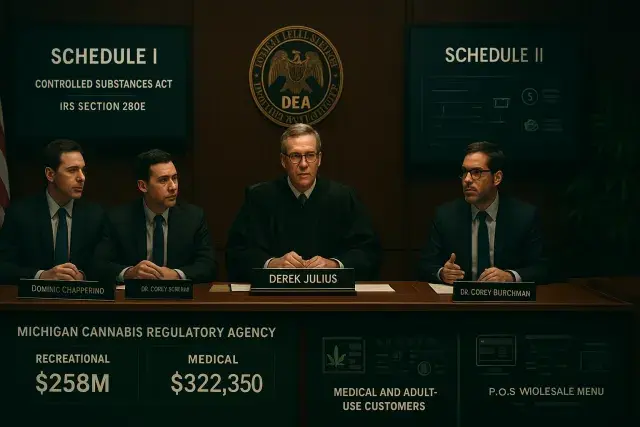
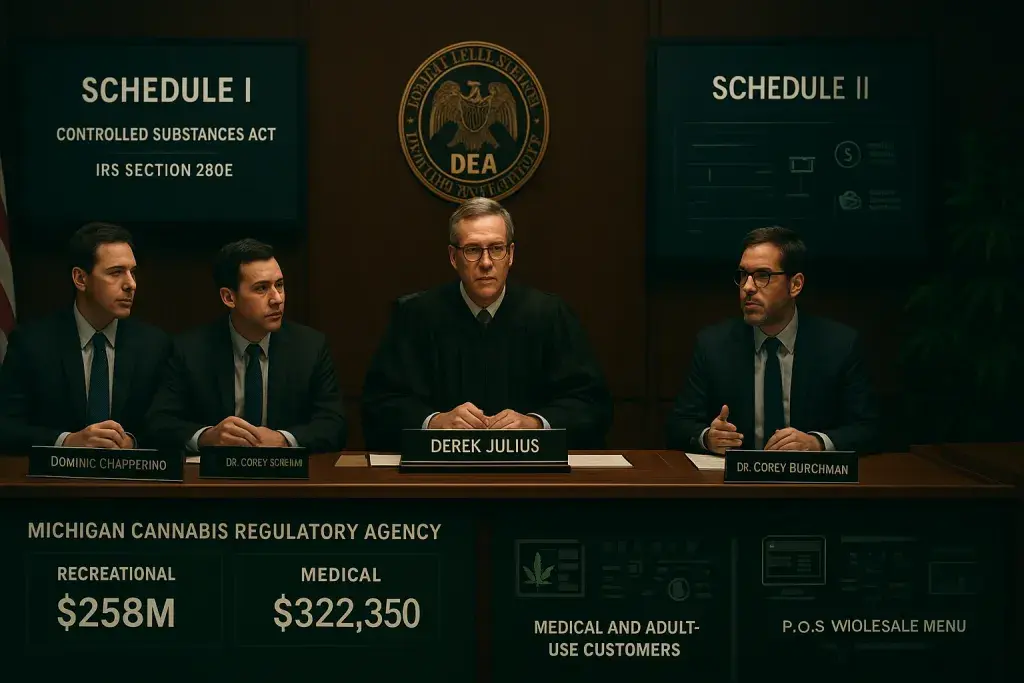
For the first time in modern federal drug policy, government witnesses spent opening day of the DEA's marijuana rescheduling hearings defending the medical value of cannabis - not denying it. The hearing, which began June 29 at DEA headquarters in Arlington, Virginia, is the formal administrative process to determine whether marijuana should move from Schedule I to Schedule III under the Controlled Substances Act. It is scheduled to run through July 15. What happens inside that hearing room carries real consequences for every licensed cannabis business in the country, from single-store dispensaries to multi-state operators managing complex compliance obligations across multiple regulatory regimes.
Among the witnesses on opening day was Dominic Chiapperino of the FDA's controlled-substance staff, who defended the federal scientific review supporting Schedule III treatment - including findings on accepted medical use, reduced abuse potential relative to Schedule I and II substances, and lower overdose risk compared to opioids and alcohol. Dr. Corey Burchman, a New Hampshire anesthesiologist, testified about cannabis use in pain management, including as an opioid alternative. The arguments themselves would have been unthinkable from federal witnesses a decade ago. Operators building out compliance frameworks for adult-use retail - whether they rely on a cannabis retail platform for Colorado or a state-specific seed-to-sale system in another market - now have to track a federal policy environment that is shifting in real time, even as most of their daily legal obligations remain defined entirely at the state level. cannabis retail platform for Colorado
Here's the catch: this hearing does not federally legalize recreational marijuana. Earlier this year, the Justice Department issued an order extending Schedule III recognition to FDA-approved cannabis products and state-licensed medical cannabis. All other cannabis - including the adult-use products that drive the overwhelming majority of regulated sales in mature markets - remains federally illegal unless the broader rescheduling process now underway is completed and survives what are expected to be significant legal challenges. Administrative Law Judge Derek Julius will compile the record from these proceedings, and opponents are already positioned to challenge the rule in federal court after the hearing concludes. The road from opening statements to actual regulatory change is longer than a single news cycle.
Michigan Makes the Irony Plain
Michigan offers the starkest illustration of the disconnect between where federal policy is moving and where consumer behavior already landed. According to the Michigan Cannabis Regulatory Agency, licensed medical marijuana facilities recorded just $322,350 in sales during May. Recreational sales in the same month came in near $258 million. That puts medical cannabis at well under one percent of Michigan's regulated market - a market on pace for more than $3 billion in annual sales.
Michigan voters approved medical marijuana in 2008. The state eventually built one of the country's larger patient programs. But once adult-use sales launched and consumers could purchase regulated cannabis without physician certifications, registry cards, or annual renewals, the medical channel lost its primary reason to exist for most buyers. Dispensaries still holding dual licenses - medical and adult-use - have largely absorbed the patient-facing side of their business into general retail floor operations. The compliance overhead of maintaining a separate medical program, including distinct inventory tracking, patient verification, and METRC log requirements, produces diminishing returns when medical sales represent a rounding error against total volume.
Ohio's Dual-Use Structure Faces a Different Calculation
Cross the border into Ohio and the picture changes. Ohio operates a more active dual-use structure, with a significant number of dispensaries serving both registered medical patients and adult-use customers through the same licensed facilities. Federal recognition of medical cannabis under Schedule III carries more immediate practical weight in a state where the medical channel still moves meaningful volume and where operators have built workflows - patient intake, medical-only product lines, physician coordination - around that designation.
That matters operationally. If federal medical recognition creates downstream advantages - cleaner banking relationships, more cooperative payment processing, or easier access to certain financial products - Ohio's dual-use operators may be positioned to benefit sooner than Michigan's adult-use-dominant retail base. In practice, though, any such advantages depend heavily on how banks, payment processors, and federal regulators interpret the new classification. Most financial institutions serving cannabis businesses have not moved quickly in response to incremental federal signals.
The 280E Question Sits at the Center of Every Operator's Tax Strategy
Broader rescheduling - if it ultimately covers adult-use marijuana, not just medical - is what cannabis businesses are watching for most closely on the financial side. IRS Section 280E currently bars businesses trafficking in Schedule I or II controlled substances from deducting ordinary and necessary business expenses on federal returns. Rent, payroll, marketing, and most operating costs cannot be deducted. For dispensary operators already running on compressed margins in competitive adult-use markets, the effective federal tax rate under 280E can dwarf what an equivalently sized business in any other retail category would owe.
Moving cannabis to Schedule III would, in theory, remove it from the 280E prohibition - potentially unlocking deductions that could materially change unit economics for licensed retailers. What's striking here is that even operators in markets like Michigan, where adult-use sales are massive and medical is nearly gone, have enormous exposure to 280E. A business doing $5 million in recreational sales annually is no less subject to the disallowance than one doing the same volume in medical sales. The relief, if it comes, benefits the adult-use industry as much or more than the medical channel.
The timing, scope, and IRS guidance around any 280E change remain unresolved. The hearing record must be compiled, legal challenges must be addressed, and tax authorities must issue formal guidance before operators can restructure their accounting positions. Compliance teams and cannabis-specialized CPAs will need to watch this closely - not just for the headline outcome, but for the implementation details that determine what operators can actually claim and when.
What Operators Should Be Tracking Now
The hearing runs through July 15, with a recess scheduled July 3 through 6. After the record closes, the process moves to legal review and, almost certainly, federal court. Nothing about the current timeline suggests operators should make material business or compliance decisions based on rescheduling alone - not yet.
What is worth tracking: whether federal medical recognition begins to influence banking access or payment processing terms for dual-use licensees; how state regulators in markets like Ohio respond to any new federal signals around medical cannabis; and how the IRS positions itself relative to a potential Schedule III classification for 280E purposes. Those are the levers that actually touch day-to-day dispensary operations, wholesale contracting, and retail pricing strategy.
Federal drug policy has moved further in the past three years than in the previous three decades. That's real. But for the licensed operator managing a POS system, a compliance log, and a wholesale menu on a Tuesday morning, the regulatory environment they operate in is still almost entirely state-defined. Until the broader rescheduling process concludes - and the courts and the IRS weigh in - that isn't changing.