
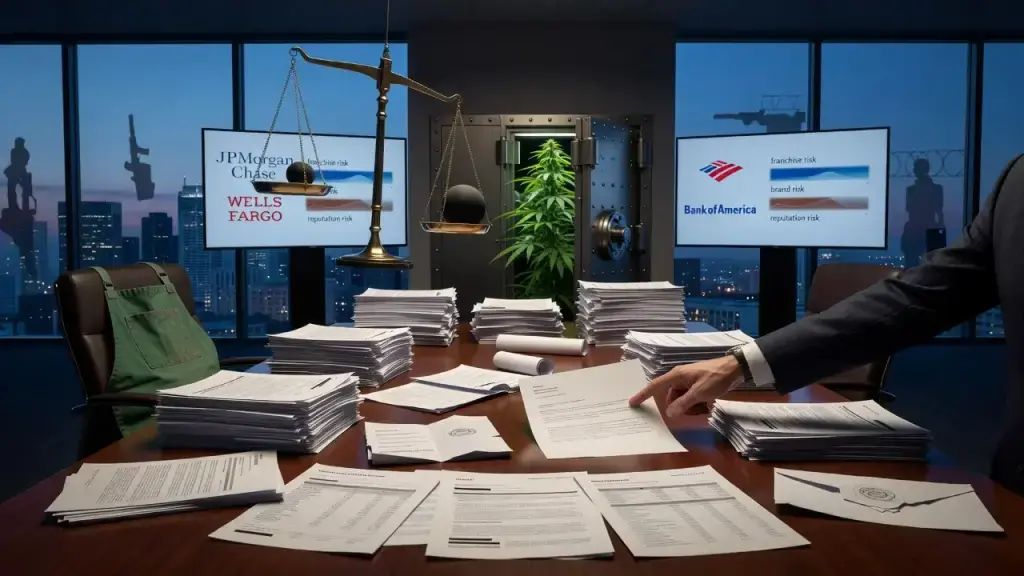
The Office of the Comptroller of the Currency has spent months digging through the account-closure practices of the nation's largest banks, and the findings land close to home for the cannabis industry, where reputational caution has long dictated who gets a business checking account and who doesn't. The agency's new "debanking" report, released Wednesday, confirms what many plant-touching operators already suspected: banks weigh public perception heavily when deciding whether a customer is worth the trouble, even when the underlying business is legal.
That matters for cannabis retail because the industry has operated for years at the exact intersection the OCC examined - federally legal banking meeting state-legal, federally illegal commerce. If a bank will cut off a gun dealer or a detention-center operator over "franchise risk," it's not hard to see why so many dispensaries still struggle to find a reliable depository relationship.
Reputation Risk Isn't Going Away, It's Getting Rebranded
The OCC reviewed roughly 420,000 pages of internal bank documents from nine major institutions covering 2020 through September 2025, and the picture that emerged wasn't one of clean, rules-based underwriting. Employees at JPMorgan, Wells Fargo, Bank of America and others were shown debating customer loyalty, shareholder petitions and the mood of advocacy groups before making account decisions. For cannabis operators, this is familiar territory. Dispensary owners have spent a decade hearing "it's a risk appetite issue" from banks that won't say the word cannabis out loud.
What's striking here is the OCC's admission that some banks simply renamed the practice. Reputation risk became "franchise risk" or "brand risk" on paper, but the underlying calculus - will this relationship embarrass us - stayed intact. That's a caution flag for any cannabis business counting on policy language alone to signal real change in banking access.
Why This Echoes the Cannabis Banking Fight
Cannabis compliance teams have built entire playbooks around proving legitimacy to banks: seed-to-sale tracking data, METRC reporting, documented tax compliance under IRC 280E, audited point-of-sale records. All of it exists because banks have treated the industry as a reputational liability rather than a straightforward Bank Secrecy Act risk category. The OCC's report touches this directly, noting it will keep examining whether anti-money-laundering requirements have become a pretext for account terminations unrelated to actual money-laundering concerns.
That line should get attention from multi-state operators and ancillary service providers alike. If regulators conclude that BSA compliance has been used as cover for reputational decision-making, it opens a door - however slowly - toward clearer, risk-based standards for serving cash-intensive, state-legal cannabis businesses rather than blanket avoidance.
What Operators and Payment Providers Should Watch
The practical takeaway for dispensary operators, wholesalers and fintech vendors serving the cannabis supply chain isn't that debanking is ending. It's that the rationale behind it is getting more scrutiny, and that scrutiny could eventually reshape how banks document and justify account terminations.
- Expect continued unevenness: some banks will tighten underwriting criteria, others will quietly keep subjective reputational review in place.
- Compliance documentation - COAs, tax filings, inventory shrinkage logs, compliant packaging records - remains the strongest leverage a cannabis business has when applying for banking services.
- Cashless payment and ACH workaround providers should anticipate more regulatory attention on how they represent cannabis-adjacent transaction risk to banking partners.
- Any federal movement on BSA guidance clarifying "risk-based" application could matter more to cannabis banking access than incremental state licensing reform.
None of this changes the baseline reality for retailers: cannabis remains a Schedule I substance federally, and banks still have to balance that fact against state-legal operations. But a regulator publicly questioning whether reputational bias - not actual financial risk - drives account closures is not nothing. For an industry that has spent years banking in cash, carrying excess compliance overhead, and absorbing wholesale pricing pressure partly caused by limited financial access, even incremental clarity from the OCC is worth tracking closely.